


Preparing for your Dengie Weighbridge Clinic
If your horse hasn’t been weighed before, there are some steps you can take to prepare them before we visit. The aim is for this to be a positive experience for you and your horse and so we have collaborated with Rosa Verwijs MSc. FHEA CEBC ABTC-AAB, a certified equine behaviour consultant and senior lecturer from ARU Writtle, to prepare the following guidance.
Understanding your Horse’s Body Language
Whenever you are training your horse you need to watch for changes to their body language as this will tell you when they start to become tense – we want them to stay relaxed! The following are signs that your horse is becoming anxious:

- Tension in the body
- High head and neck posture
- Wide-open eyes with triangulation and wrinkling
- Flared nostrils
- Snorting
- Ears flicking back and forth
- Tail swishing
- Clamped muzzle with tight lips and tense nostrils
- Licking and chewing
- Fidgeting feet
- Swinging the quarters
- Pulling backwards
- Nipping
- Chewing the lead rope
- Freezing
- Pawing
- Head tossing
- Nodding
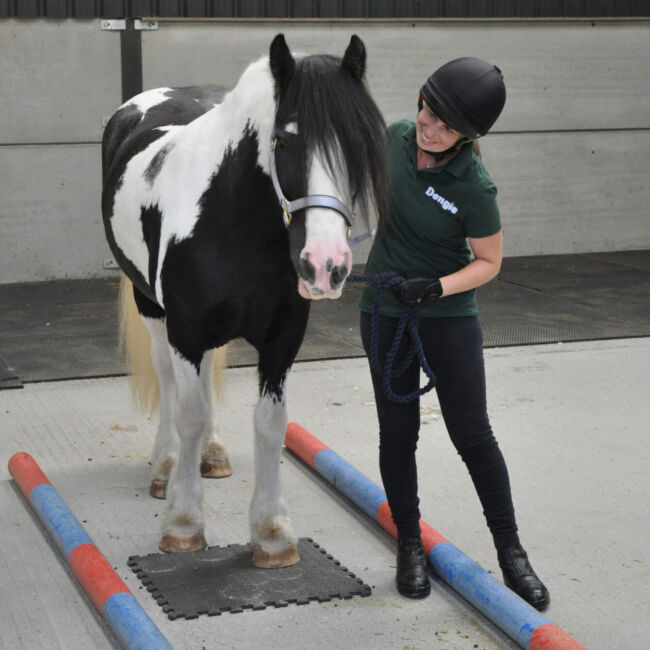
The plan is to simulate a weighbridge using poles and rubber matting as shown in the picture. It is really important the material used can withstand the horse’s weight, is flat and does not move when they stand on it or flap in the wind if an alternative to rubber is used. Once you’re happy the simulated “weighbridge” is in place you can begin your training.
Training Approaches
- Start away from the “weighbridge” and reinforce each step your horse makes towards it with a verbal marker “good” and follow up with a food reward. Have food rewards in your pocket or a bumbag.
- Gradually approach the “weighbridge”
- Cue forward behaviour and wait at least 10 seconds before asking again if they do not respond.
- Make sure to use clear forward cues and give your horse time to eat the food and then give their attention back to you before moving onto the next step in the training plan below.
- Starting from a good distance where the horse is relaxed and not worried about the “weighbridge” (could be 20 metres).
- As you lead the horse towards the “weighbridge” watch for the moment the horse focuses his attention on the “weighbridge” and stop the horse before they show signs of anxiety or tension.
- Stay still and wait for the horse to show signs of relaxation, then ask them for one more step before turning and leading them in a curve away from the “weighbridge” back to the starting point.
- This method may be more useful if your horse is not used to being trained with food, or is extremely fearful. It reinforces the horse for doing the correct behaviour with the reward they desire the most at this point which is distance between themselves and the “weighbridge”. Once they realise they have some control and you are listening to them becoming tense they will start to relax more and actually want to go closer.
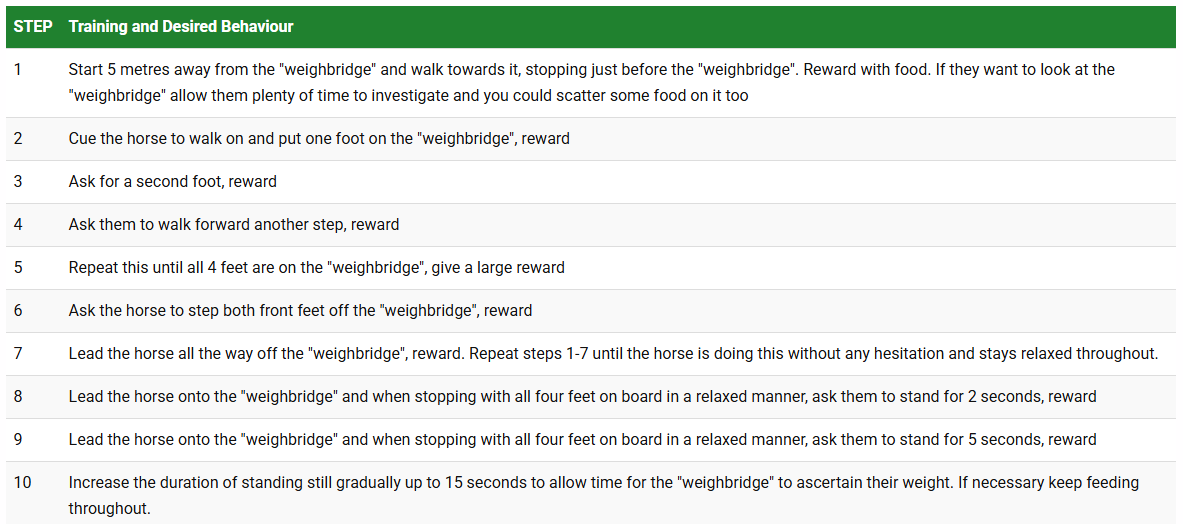
Training Plan (with or without food)
Between each step wait for the horse to relax and focus their attention back to you before cueing the next behaviour. If using food rewards make them bigger while the horse is standing on the “weighbridge” to reinforce this goal behaviour. Remember if you don’t have a “weighbridge” you can use something else for them to walk over and stand on, such as rubber matting. This will help when it comes to using the “weighbridge” as they will understand the cues and reinforcers used during the training sessions.
Top Tips for Successful Training

Try to stay relaxed yourself and don’t become frustrated. Use the lightest pressure on the leadrope. If the horse becomes too anxious and you notice any of the above signs or body language stop training and take them away from the training area. Allow them some time to relax and try again with some training in a different area before you reapproach the “weighbridge” location.
Train for short periods at a time (6-8 minutes) then give the horse a break, ideally with some forage, water and company of another horse. Multiple short training sessions are more productive than one long one.
Don’t be disappointed if they commit to a step and then get worried, just lead them away quietly, reward them for stopping at a distance and start again when they are relaxed.
If you have serious issues with the “weighbridge” that means you are unable to attempt or complete the above training, consider asking an approved behaviourist for help. Recommended behaviourists that are qualified and have insurance can be seen on the Animal Behaviour and Training Council’s website here: https://abtc.org.uk/practitioners/