The mineral content of plants tends to reflect the soils they grow in. Different plant species adopt various strategies or develop abilities to source more minerals, but the minerals still must be there for the plants to access them.
Minerals are usually divided into macro- and micro- groups with the latter also being described as trace minerals. The categories distinguish minerals by the amounts needed in the diet, not their relative importance. Macro-minerals are usually measured in g/kg or a percentage, whereas micro-minerals are usually measured in mg/kg.
Another key point to note is the origin of the minerals. Those from plants are often referred to as organic sources – this is not in relation to them being chemical free, but just differentiates them from those that are from the earth; essentially those that are mined which are referred to as inorganic.
Minerals from plants – the organic form – are usually more bio-available to the horse. Inorganic sources can often be reactive and so look to stabilize themselves by latching on to other minerals which makes them more difficult to absorb. To reduce this problem you may see that manufacturers have used chelated minerals which means they are mined sources of minerals attached to other molecules to stabilize them thereby improving absorption from the gut.
Macro-minerals in alfalfa
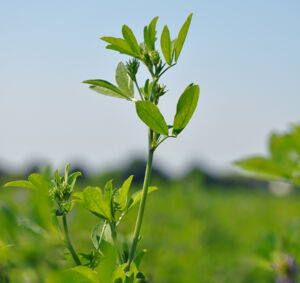
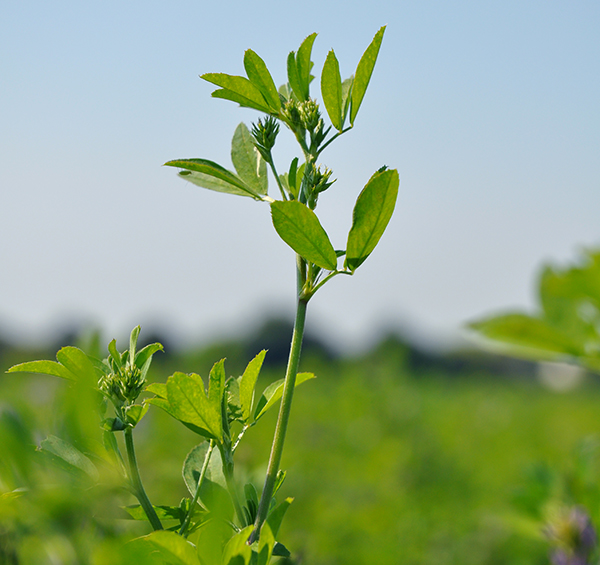
In addition to the soil, other factors determine the mineral content in forages such as alfalfa. The level of magnesium for example, declines in alfalfa as the plant ages with the highest levels found in the first stage of development. At Dengie, we harvest the alfalfa before it matures to maximize its nutritional value. This is in contrast to the USA and some parts of Europe where the alfalfa is made into hay and so is very mature at the point of harvest.
The age of the plant also has an impact on where minerals are stored within the plant with the relative proportion increasing in leaves as the plant gets older. Obviously, this reflects the fact that as the plant matures and grows taller there are more leaves available to store the minerals but it is a key reason why we work hard to ensure the leaves are included in the finished product as it ensures horses consuming it receive the maximum nutritional benefit. The leaves are prone to shattering when they are dried which can make the product look dusty and this is why we add a liquid coating as it disperses the highly nutritious leaves evenly throughout the bag.
If horses at rest or in light work are fed plenty of forage, they are rarely short of macro-minerals. If forage intake is limited to manage body weight of good doers for example, then a shortfall can occur. The use of a supplement or balancer can help to counteract shortfalls of macro- and micro-minerals and is particularly beneficial for horses on restricted forage rations.
Some supplements contain single minerals in isolation. It is rare for a horse to require a macro-mineral in isolation and it is important to use them with care as supplementing one mineral can have a significant impact on the absorption of another.
Magnesium is often found in products marketed as calmers. Anecdotally horse owners report them working for a while but then the effect wears off. This can be due to the fact that once a deficiency or shortfall has been addressed, supplementing with more magnesium than required is unlikely to have an effect. There is no published evidence to show that supplementing above know requirements for magnesium has any impact on behaviour. Counteracting a deficiency of any nutrient is likely to be beneficial though!
FACT: Plant based sources of calcium such as alfalfa are much easier for the horse to absorb than inorganic sources such as limestone flour.
Micro-minerals in alfalfa
Micro-minerals are the most likely to be deficient in horse’s rations as UK soils are often deficient in them; examples being selenium and copper. Even horses at rest turned out 24/7 are likely to need some form of supplementation of micro-minerals to keep them in top condition. Micro-minerals have many important functions in the body including as part of the anti-oxidants that deal with the effects of exercise amongst other things.
Cobalt is a micro-mineral required by microorganisms to synthesize vitamin B12 which is important in many biochemical pathways. It is a mineral that has been used and abused by some racehorse trainers in the past who supplemented at very high levels to try and achieve a competitive advantage and so subsequently, its inclusion in feeds and supplements has been more closely monitored around the world. However, it has been found to occur naturally in plants such as alfalfa but at much lower levels than are used to try and manipulate performance. It is thought to enhance fibre digestion though and so its presence may go some way to explaining why horses do so well on alfalfa.







 When researching for a product suitable for horses with