

Feeding the Poor Doer
Feeding the poor doer can be a challenge and there are a multitude of reasons why a horse might be underweight or struggle with their condition – for this reason, the solution is not always just as simple as feeding them more. The horse’s forage and grazing are arguably even more important to think about than what’s going into the bucket, and any underlying health problems also need to be taken into account.
What causes weight loss in horses?
Weight loss can be caused by a number of factors, some of which can be managed with feed or are feed-related health conditions. This is why there is not a clear, “best” conditioning feed, as certain feed types are more suited to some horses than others, and health problems, such as laminitis or colic, also need to be considered. Poor dentition, such as sharp edges or loose teeth, could result in the horse struggling to chew the feed properly and thus being unable to digest it fully, as well as affecting appetite. A worm burden due to poor worming management can also cause weight loss regardless of what is being fed.
Stressful environments where the horse is constantly being disturbed or kept out of sight of other horses might also cause loss of condition, and it is not uncommon for horses to lose weight after a long journey or moving yards. There is an increasing amount of evidence linking stress and Equine Glandular Gastric Disease (EGGD) (Sykes et al, 2019), which highlights the importance of maintaining a calm environment for your horse as much as possible. This can include ensuring continuity of human carers and reviewing any practices on the yard that may be distressing for them.
If the weight loss is very sudden or out of character for your horse, then the issue should always be discussed with your vet to try and determine the cause. However, if there are no underlying problems that need to be treated or managed, you might need to review their feeding regime to help support condition and weight gain for horses.
Feeding horses for weight gain
When researching weight gain food for horses, it is important to keep in mind that calories and energy are the same thing, with calories representing a measurement of energy. As humans we tend to use the term ‘calories’ when talking about weight gain and loss, but essentially if we consume more energy than we use, this will result in weight gain, and the same applies in horses.
The horse’s grazing and forage intake is usually the best place to start when reviewing the ration. Good grazing provides the most digestible source of fibre, and in the spring this can provide more than double the energy requirements of a horse in light work. Grass is usually a highly palatable fibre source, and many horses will generally be happier when out in the paddock. However this is not always the case, so monitor your own horse’s behaviour to check they don’t appear to be distressed or fence walking (and not eating) when out in the field.
Some yards are lucky enough to have an unlimited supply of grass but if that’s not the case then alternative sources of conserved forages may be needed at times when grass availability and quality is reduced, or in inclement weather conditions such as frost and snow. If you are providing supplementary hay or haylage in the field, ensure that the supply is not being monopolised by more dominant members of the herd and that your horse is able to access it freely. Using smaller piles placed around the field may be required in this instance if the horses are not able to be separated.
The type and amount of forage provided is also an important factor to consider when it comes to weight gain for horses. Forage makes up at least half of most horse’s rations and so if it is of poor nutritional quality, it will have a significant impact on the horse’s condition. Forage quality is largely determined by how digestible it is – there are different types of fibre found in feeds, ranging from the very digestible pectin to the less digestible cellulose. High levels of lignin, an indigestible substance that gives a plant structure, will significantly reduce the digestibility of a forage. The older and taller a plant gets, the more lignin is present, which is why later cut hays will tend to be less conditioning than earlier cuts. Earlier cuts will typically be softer and leafier, and therefore more digestible and better for weight gain in horses.
Generally speaking, haylage or wrapped hay tends to be cut earlier than hay which is why horses tend to do better on it. However this is not always the case, and a very soft, early cut of hay may end up being better for weight gain than a haylage, so it’s important to assess what you have available. More information on the differences between hay and haylage can be found here.
In most cases there is no reason to restrict forage for poor doers. This means it should be fed to appetite, so they always have plenty available. The greater the contribution the forage makes to supplying your horse’s energy requirement, the less bucket feed you should need to use, which is better for their digestive health and usually the most cost-effective way to feed.
Even when plenty of forage is provided, some horses may still not eat enough. For the underweight horse, it can be helpful to weigh how much hay is provided and then weigh what is left at the end of the day so that you can monitor what has been consumed. As a guide, a horse with no access to grass should ideally be consuming a minimum of 1.5% of their bodyweight of forage on a dry matter basis per day, though for horses fed free access forage we would expect an intake of closer to 2% of their bodyweight on a dry matter basis. For a 500kg horse, this would equate to 7.5-10kg per day.
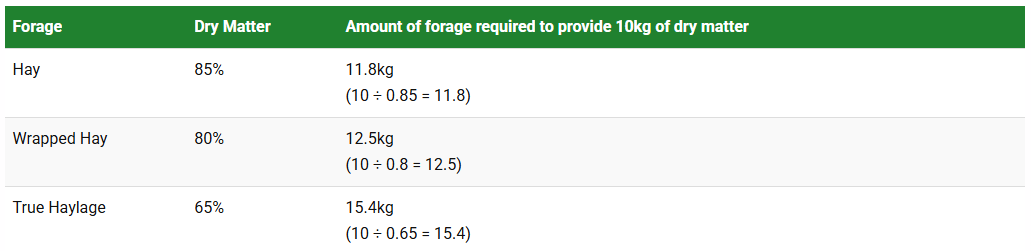
However, all forages naturally contain some water which essentially ‘dilutes’ the amount of fibre being provided – different forages will vary but generally hay will have a dry matter content of around 85% and haylage will be lower at around 65%. Wrapped hay is usually somewhere in between at around 80% dry matter. If you have a regular supply of forage, it is possible to have it analysed to assess its dry matter content, but if this is not possible then the figures above are a good place to start. To calculate how much forage your horse should be consuming, simply divide the amount of dry matter required by 0.85 if you are feeding hay, or 0.65 if you are feeding haylage.
To illustrate the importance of knowing the dry matter of a forage, the following table shows the different quantities required of each forage type to provide 10kg of dry matter:
If your horse isn’t eating enough, consider the quality of the forage. Ensure it is clean and free from mould and dust – if other horses on the yard are also not keen then this could indicate a problem with the forage and so you may need to look at an alternative source. Earlier cut, softer forages will not only provide more calories but are also often more palatable, meaning that your horse may be inclined to consume it in greater quantities which is also advantageous when it comes to weight gain. Haylage or steamed hay can sometimes be more palatable than dry hay so these are other options to consider for the poor doer. More information on feeding the fussy horse can be found here.
The importance of good dentition
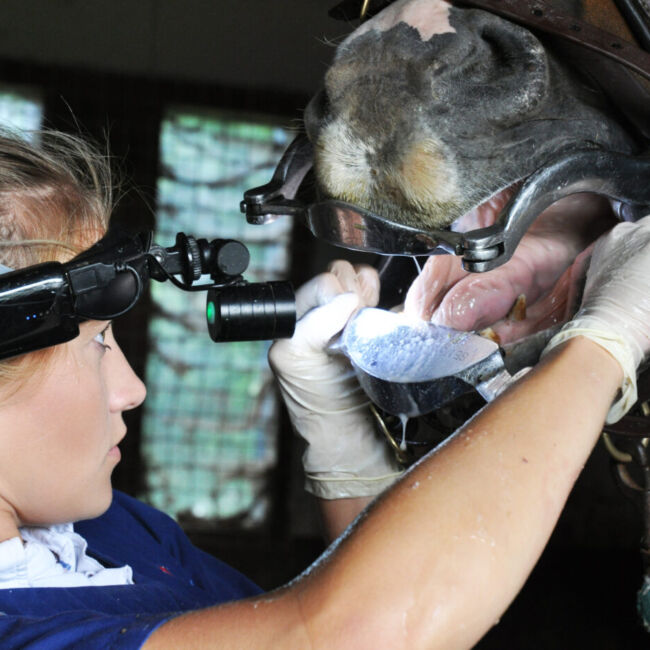
It is also important to bear in mind that a reduced appetite for forage can alternatively indicate a problem with chewing. Since chewing is the first stage of digestion, dental problems can have a big impact on your horse’s ability to digest their feed and forage. Having difficulty chewing is no longer an issue confined to older horses, and diastemata (gaps between the teeth) seem to be an increasing issue for horses of all ages. Regular checks by a vet or qualified dental technician are therefore really important.
If a horse is struggling, it’s important to find a format of fibre they can manage – short chops and mashes may be needed to ensure they consume enough. In a Dengie funded study, horses with poor dentition consumed about two-thirds less hay than horses with normal teeth. To put this into perspective, if a horse consumed 2kg rather than 6kg of an average hay, their energy intake could be around 40 MJ lower every day – it’s therefore not a surprise that horses with poor dentition can lose weight very easily. However, the horses with poor teeth in the study were able to consume the same amount of a soaked mash product – in this case, Dengie Alfa-Beet. In most situations, providing fibre in a form the horse can chew is all that is needed to promote weight gain.
Bucket feed
Once you have ensured your horse is consuming sufficient quantities of good quality forage, the next step is to look at the bucket feed. Feeds which are low in starch are a preferable choice to support digestive health. This is because horses produce comparatively low levels of amylase (the enzyme which digests starch) compared to other animals, and so the digestive system has a limited capacity to utilise starch. Starch is found in high levels in cereals, and excessive quantities of these cause a more rapid transit through the digestive tract which can result in starch reaching the hind gut, where it can cause problems. More information on the equine digestive system can be found here
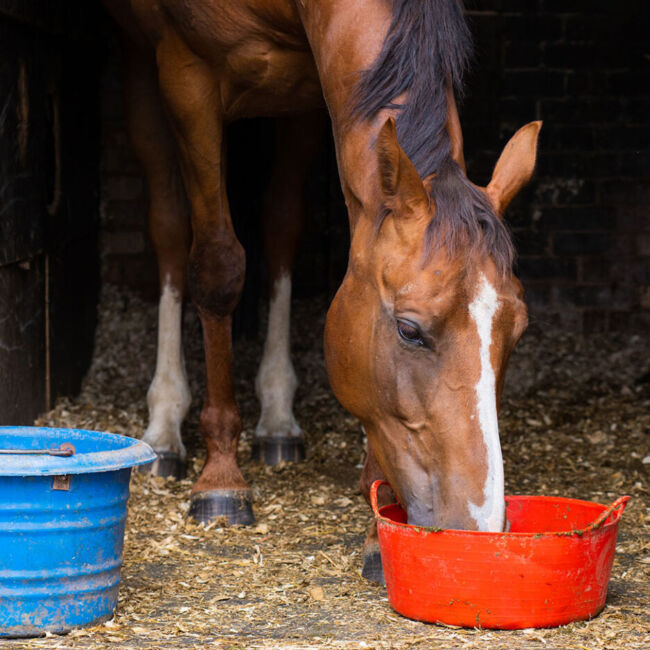
If using a nutritionally balanced feed, it is important to ensure that it is fed to manufacturer’s recommendations to provide a balanced diet. For other feed types or if you are feeding less than the recommended amount, a broad-spectrum vitamin and mineral supplement or balancer should be included alongside.
Monitoring your horse’s body condition and weight
Measuring and assessing your horse regularly is important for spotting changes early so you can address any problems quickly. If you have made changes and still aren’t seeing any improvements after 2 to 3 weeks then you should review again and consider seeking help from a professional if there are no signs of improvement after a month. It is really important to ensure you have addressed any underlying causes as whatever changes you make to the diet, they are unlikely to have the desired effect if other contributing factors are still present.
Watch the below video to learn how to body fat score your horse or pony.
Summary
- Consider the possible reasons as to why your horse may have lost weight – if the weight loss is sudden or without an obvious cause then consult with your vet in case there is an underlying issue.
- Provide access to good quality grazing where possible, if appropriate for your horse.
- Select an early cut, soft forage and feed it to appetite.
- Monitor forage intake and top up with easy-to-chew forage replacement feeds where necessary.
- Choose a bucket feed containing highly digestible fibre and oil that is low in starch to best support gut health.
- Feed little and often, especially if using cereal-based feeds.
- Use digestive aids to support fibre digestion and gut health.
References
- Dengie (2021) Unpublished data from a survey of horse owners whose horses had or were suspected to have gastric ulcers.
- Furtado, T et al (2021) Exploring horse owners’ understanding of obese body condition and weight management in UK leisure horses. Equine Veterinary Journal. 53 (4), 752-762.
- Jansson et al (2021) Straw as an Alternative to Grass Forage in Horses—Effects on Post-Prandial Metabolic Profile, Energy Intake, Behaviour and Gastric Ulceration. Animals.
- Longland et al (2011) The effect of wearing a grazing muzzle vs. not wearing a grazing muzzle on pasture dry matter intake by ponies Journal of Equine Veterinary Science. DOI:10.1016/j.jevs.2011.03.105
- Longland et al (2016) Effects of Grazing Muzzles on Intakes of Dry Matter and Water-Soluble Carbohydrates by Ponies Grazing Spring, Summer, and Autumn Swards, as well as Autumn Swards of Different Heights. Equine Veterinary Journal. https://doi.org/10.1016/j.jevs.2015.09.009
- Longland et al (2020) Strip-grazing: Reduces pony dry matter intakes and changes in bodyweight and morphometrics. Equine Veterinary Journal. https://doi.org/10.1111/evj.13416
- Macon et al (2022) Postprandial insulin responses to various feedstuffs differ in insulin dysregulated horses compared with non-insulin dysregulated controls. Equine Veterinary Journal. https://doi.org/10.1111/evj.13474
- Rendle et al (2020) Tackling obesity and related laminitis in equine patients. Veterinary Times Equine. 6 (1), 6-9.


Expert advice at your fingertips
If you’re looking for advice on the best feed, speak to one of our highly experienced nutritionists on our feedline, or for a more in-depth plan, fill out our Feed Advice Form