

Dental Issues in Horses
Healthy dentition is vital to the horse’s ability to chew. Chewing, also called mastication, is at the start of the horse’s digestive process and results in feed being ground down into smaller particles. This means that once the food is swallowed there is a greater surface area for digestive enzymes and microbes to work on to extract nutrients from the food more efficiently. When a horse has dental problems the digestive process is often less efficient and the horse can experience significant pain which may put them off eating altogether. Unsurprisingly this can soon result in weight loss. A change in diet may be required to provide fibre in a form the horse can manage which may include the use of forage replacers.
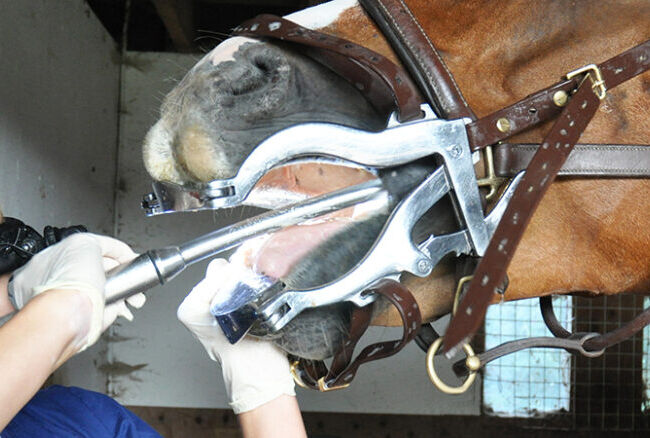
Horses have two sets of teeth in their lifetime. The first are the deciduous or temporary teeth that erupt soon after birth which are then replaced by the second permanent set of teeth. Adult horses have 36-44 teeth with the variation in number due to male/female differences and the presence or absence of canine and wolf teeth.
The twelve teeth at the front of the mouth are called incisors and these are responsible for aiding the grasping and biting of the grass or conserved forage the horse eats. The 24 cheek teeth consisting of 12 premolars and 12 molars are responsible for grinding the food into small particles. Each tooth consists of four layers. In the very middle of the tooth is the pulp which is very soft and contains the dental nerves. The pulp is surrounded by three additional layers which protect it; dentin, enamel – which is the hardest substance and forms the ridges on the chewing surface, and then finally cementum which is the outermost layer of the tooth.
Signs of dental problems or pain such as quidding in horses can be very subtle and develop over a long period of time. Things to look out for include:
- Weight loss – especially in horses that usually hold their weight well. In one retrospective study, dental problems were second only to parasite burden as a cause for chronic weight loss syndrome in horses (Tamzali, 2006).
- Taking longer to eat
- Eating less than normal especially forage
- Quidding – when a horse drops partially chewed, saliva covered forage while eating
The BHS No Pain Check Again campaign outlines many more subtle and not so subtle signs of dental disease.
Looking at the length of fibre in your horse’s droppings can also be useful for monitoring their dentition. Knowing what’s normal for your horse will help you to identify if there’s a problem. Fibre lengths greater than 3.6mm have been proposed to indicate the presence of dental abnormalities in horses (Di Filippo et al., 2018).
The horse has evolved as a trickle feeder eating little and often through the day. Their natural high fibre diet requires a lot of chewing to grind it down to smaller particles. For example, Elia et al., (2010) found that horses performed 43476.5 chews per day eating hay and only 10036.8 chews per day eating pellets. This is because the fibre in the pellets has already been ground down and so some of the work has been done for the horse.
The horse has hypsodont teeth as a natural adaptation to their diet. A hypsodont tooth has more crown above the gumline allowing for the wear and tear caused by a high fibre diet. The reserve crown below the gumline with a short root contrasts with human teeth which are shorter crowned and longer rooted and are known as brachydont. As the horse’s teeth wear, more crown erupts to replace it so that the horses’ teeth continually erupt over their lifetime which enables them to cope with the relatively high levels of silica found in forages. Silica is very abrasive which, combined with the amount of chewing forage requires, results in dental wear over time. There is, however, a finite capacity to do this, which means that older horses can literally run out of teeth.
Study: The Effect of Poor Dentition on Forage Intake
In 2007 Dengie were involved with a study, in association with Writtle University College, to investigate how age-related dentition affected the consumption of fibre. The trial involved 12 horses and compared the amount of 3 different types of fibre (hay, Dengie Hi-Fi Senior and Dengie Alfa-Beet) they were able to consume within a certain time period.
It was expected that a horse with poor dentition would consume less food in the same time as a horse with no dentition issues, however, the extent to which this happens was unknown. The reduction in intake was most significant for hay; those with poor teeth consumed up to two-thirds less hay in the same time period as those with no dental issues. The smallest difference was with the soaked product and only a slight reduction was seen with the short chop product. Some of those with dental issues actually refused to eat the hay completely, whereas the soaked product was not refused at all. This shows just how significant dentition is to fibre intake.
These results indicate why it is common to see considerable weight loss in horses with poor dentition – especially over winter when forage is their primary fibre source. The study also illustrates how easy it is to provide an alternative fibre source for these horses and ponies. With soaked products showing the least difference between good and poor dentition, these feeds make ideal partial or complete forage replacers for horses with very poor teeth.
Types of dental problems in horses
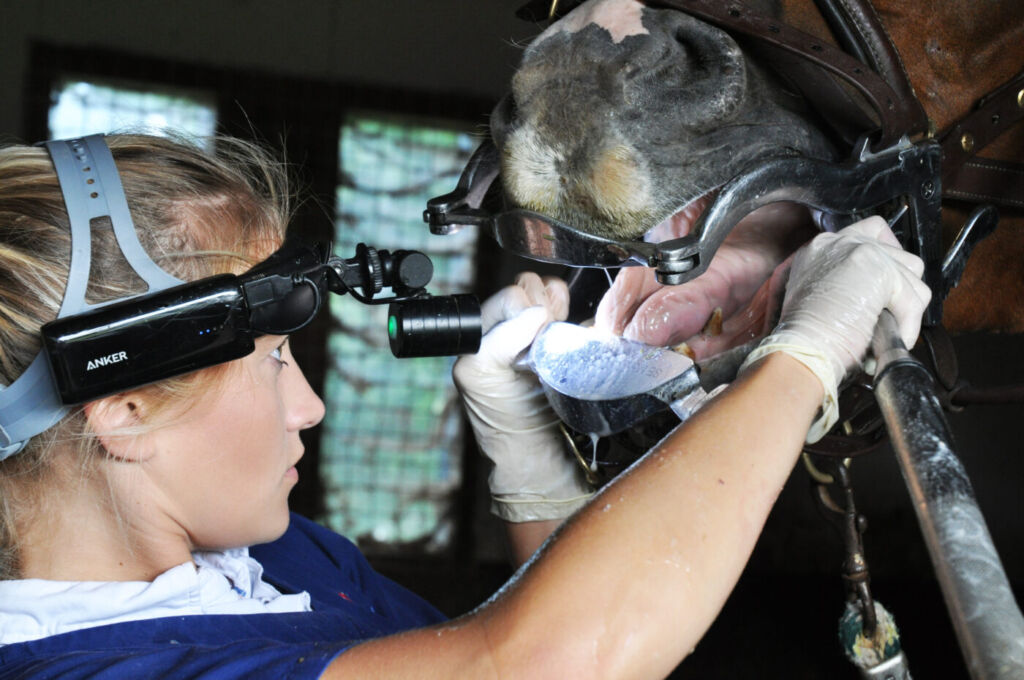
Regular dental checks are necessary to keep your horse’s teeth in good working order and to identify any issues. Dental checks and treatment should only be carried out by suitably qualified individuals including vets and Equine Dental Technicians (EDT) registered to either the British Association of Equine Dental Technicians or category 2 members of the Worldwide Association of Equine Dentists (WWAED).
In Equine Dentistry, Dixon et al., (2007) discuss many of the different dental disorders that can occur including the following common conditions:
Any asymmetry in the position of the jaw or individual teeth can result in uneven dental wear. Pain and mechanical obstruction caused by dental overgrowth can restrict the horse’s chewing action which then restricts saliva production and movement of food in the mouth which can then lead to additional problems.
In routine dental checkups your vet or EDT will look for the presence of enamel overgrowths which may be described as hooks or points which they will then rasp to prevent them causing sores on the horse’s cheeks and other problems. Shear mouth, wave mouth, step mouth and smooth mouth are also examples of wear abnormalities.
Healthy cheek teeth should be very tightly packed together in a row. Diastema is a term used to describe abnormal spaces between the teeth where food can start to become lodged. As the food decays it causes disease to the teeth too known as periodontal disease. Diastema can occur at any age but is more common in older horses and ponies who are literally running out of teeth. As teeth erupt over the course of their lifetime there are more likely to be gaps between teeth at the gumline. These gaps are called senile diastema.

Describes inflammation of the supporting structures of the teeth, for example the gums and is often secondary to other issues such as diastema. It can eventually lead to the loss of the tooth.
Dental caries or tooth decay results from a chain of events that starts with bacterial fermentation and the production of acid which results in demineralisation of the teeth. Dental caries can result due to other dental abnormalities and can predispose the horses’ teeth to an increased rate of dental wear and potentially fracture.
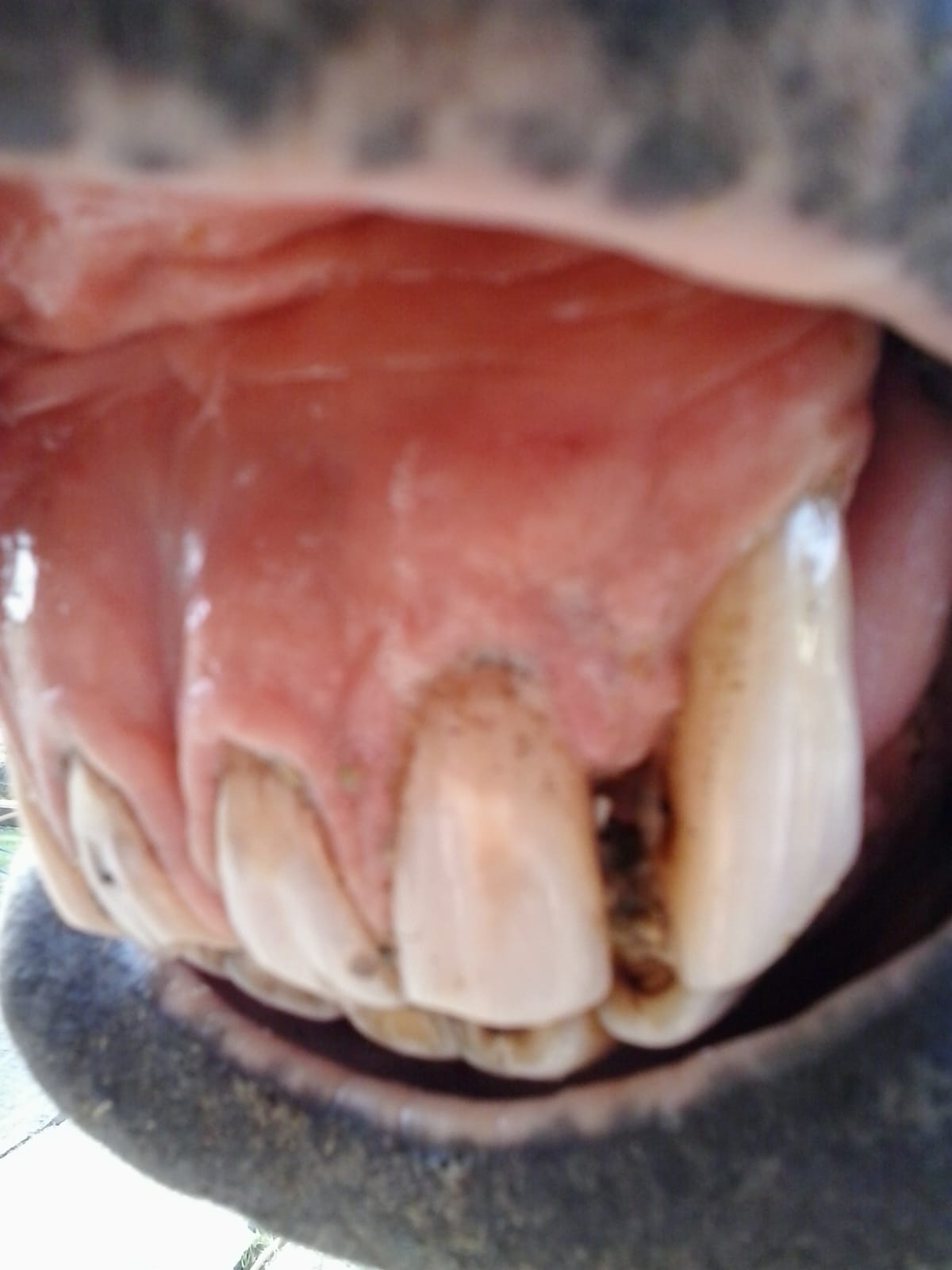
EOTRH is a dental problem that affects the incisors and canine teeth of aged horses. EOTRH causes periodontal disease, with resorption or proliferation of calcified dental tissue. It is a very painful condition first identified in 2008 (Vogt, 2014) that inhibits the horse’s ability to bite or prehend food and currently treatment involves the total extraction of the incisors.
Can diet affect dental health in horses?
We understand that in our own diet lots of sugary or acidic foods, combined with poor dental hygiene are more likely to result in tooth decay (dental caries). Can the same be said for our horses?
Based on the available evidence it seems that when it comes to diet and dental health, there may potentially be some link to diet although causal effects have yet to be truly established. The over-arching message to support dental health is to allow access to plenty of forage for those that can chew and don’t have dental abnormalities. Chewing promotes the production of saliva which contains bicarbonates that buffer acidity within the mouth as well as the stomach.
Feeding the Horse with Dental Disease
Your vet or equine dental technician will advise as to whether your horse requires an alternative to long length forages. Those starting to struggle with their long stem forage may still be able to manage a short chop fibre feed as some of the work has been done for them. For those with more severe dental issues an entirely soaked fibre ration may be required.
For further information on feeding a forage replacer to your horse click here.
References
- Bonin, S.J., Clayton, H.M., Lanovaz, J.L. and Johnston, T. (2007) Comparison of mandibular motion in horses chewing hay and pellets. Equine Veterinary Journal, 39(3), 258-262.
- Borkent, D., Reardon, R.J.M., McLachlan, G., Smith, S., and Dixon, P.M. (2017) An epidemiological survey on the prevalence of equine peripheral dental caries in the United Kingdom and possible risk factors for its development, Equine Veterinary Journal, 49(4), 480-485. https://doi.org/10.1111/evj.12610
- Daniels, S.P., Whiteside, E.J., Martin, S., Moore-Colyer, M.J.S., and Harris, P. (2024) Straight from the horse’s mouth: The effect of different feedstuffs on oral pH in horses and ponies. Journal of Equine Veterinary Science https://doi.org/10.1016/j.jevs.2024.105181
- Di Filippo, P.A., Vieira, V., Rondon, D.A., Quirino, C.A. (2018) Effect of Dental Correction on Fecal Fiber Length in Horses, J. Equine Vet. Sci, 64, 77-80. DOI: 10.1016/j.jevs.2018.02.016
- Dixon, P. M., Du Toit, N., & Dacre, I. T. (2011). Equine dental pathology. In K. J. Easley, P. M. Dixon, & J. S. Schumacher (Eds.), Equine Dentistry (pp. 129-147). W.B. Saunders Company. https://doi.org/10.1016/B978-0-7020-2980-6.00010-6
- Elia, J.B., Erb, H.N., Houpt, K.A. (2010) Motivation for hay: Effects of a pelleted diet on behavior and physiology of horses. Physiol. Behav., 101, 623–627.
- Gere, I. and Dixon, P.M. (2010) Post mortem survey of peripheral dental caries in 510 Swedish horses. Equine Veterinary Journal, 42 (4), 310-315.
- Jackson, K., Kelty, E., and Tennant, M. (2018) Equine peripheral dental caries: An epidemiological survery assessing prevalence and possible risk factors in Western Australian horses. Equine Veterinary Journal, 50, 79-84.
- Tamzali, Y (2006) Chronic weight loss syndrome in the horse: a 60 case retrospective study. Equine Vet. Edu. 18 (6), 289-296
- Vogt, C (2014) Dental Care for Older Horses, Proceedings 7th European Workshop on Equine Nutrition, “The impact of nutrition on metabolism” 28th September-2nd October 2014, Leipzig, Germany 59-61.



Expert advice at your fingertips
If you’re looking for advice on the best feed, speak to one of our highly experienced nutritionists on our feedline, or for a more in-depth plan, fill out our Feed Advice Form