

Equine Faecal Water Syndrome
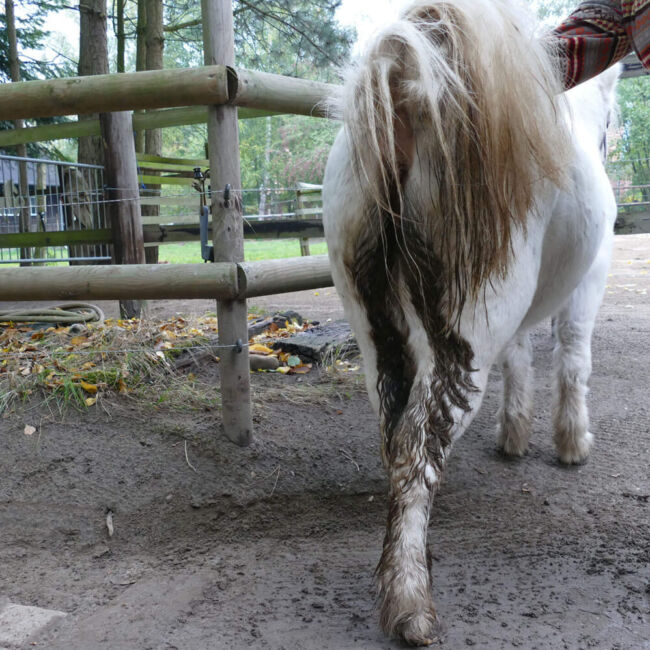
Equine Faecal Water Syndrome (EFWS) is a condition in horses where faeces are passed as normal but before, during or after this, the horse passes faecal water. The phenomenon is also referred to as Free Faecal Water or Free Faecal Liquid.
Whilst the condition isn’t necessarily associated with weight loss, colic or other digestive issues, it may cause management problems such as soreness around the horse’s bottom and on their back legs. It can also result in significantly increased use of bedding materials which increases costs and work for the horse owner.
What causes Equine Feacal Water Syndrome?
Frustratingly, no definitive causal or risk factors have been definitively identified although a couple of studies have been conducted that provide some suggestions as to what contributing factors might be relevant.
A study in Germany explored risk factors in pleasure horses. The study surveyed horse owners of horses with EFWS and asked questions about feeding and management. The findings of the survey suggest that there was no correlation between many of the factors anecdotally thought to be relevant such as worm burden and poor dentition. The study did find some seasonality with about one-third of the affected horses only showing symptoms in the winter months. In addition, many, but not all, of the owners reported their affected horse to be lower down the social hierarchy. The researchers therefore highlight that stress may be a contributing factor for some cases.
The study in Germany found no correlation between the use of wrapped forages such as haylage and EFWS. Another study carried out in Sweden and Norway (Lindroth et al, 2021) explored this area too collecting data over a year long period from horses and ponies that were over two years of age and had a history of EFWS.
The Scandinavian study found no definitive link between wrapped forages and EFWS although some horses improved when changed to hay. However, this seems to be linked to a change of forage rather than the forage type as some horses improved when changing from one wrapped forage to another one so it doesn’t appear to be the case that the wrapped forage per se is the cause of the problem. Interestingly there was also no link between the feeding of alfalfa and EFWS.

It is likely that, as with many other issues affecting the digestive system, EFWS is a multi-factorial problem with stress being a contributing factor. Our understanding of how stress impacts digestive health and function in humans is evolving as more studies investigating conditions such as Inflammatory Bowel Disease (IBD) are carried out. A key concept from this work to date is that the events or factors that trigger issues like IBD might not be what perpetuates it which is why these conditions can be so hard to treat and manage. So in effect, we might actually be looking for different things that trigger the initial problem to those that mean the problem persists!
Feeding and management advice for horses with EFWS
Keeping stress to a minimum is often easier said than done when we have limited options for where we keep our horses. If your horse has a persistent EFWS issue then a change of environment might be helpful. It may be a change of companion/s might help reduce their stress so perhaps a change of field would help or, if your horse is on livery and cared for by one or more other people, you might want to explore how that is impacting your horse. The handler and number of handlers has been identified as a risk factor for other stress-related conditions. Try keeping a diary of your horse’s feed and management around EFWS to see if there are any recurring things that happen just before an episode occurs.
As no definitive diet related risk factors have been established, the starting point is to implement good basic feeding practices also known as the rules of feeding. Feeding plenty of forage appropriate to the horse’s condition and other requirements are key. All horses should receive a minimum of 1.5% of their bodyweight as forage (including pasture) each day on a dry matter basis. If you are not sure how to check if your horse does consume this much then contact an equine nutritionist for help and advice.
On the basis of the findings from studies carried out to date, there is no rationale for avoiding wrapped forages even though they usually contain more moisture than hay. Wrapped forages tend to be more digestible and so horses can usually extract more from it and therefore hold their weight better so they are usually the preferred option for poor doers. However, because so little is understood about EFWS it is important to apply common sense and so if you find that wrapped forages don’t suit your horse, they are best avoided.
As one study has found that changing forage helped in some cases, it may also be worth sourcing forage from a different supplier just to see if it makes a difference to your horse. As with any change to the diet, try to do it gradually over 7 to 10 days.
Another finding suggested there may be a possible link with horses being turned out on soil or bare paddocks as opposed to grass paddocks. The researchers suggest that horses may pick up soil as they eat off the ground which is an area requiring further research. If you have very sparse grazing then try to put any supplementary forage in feeders or on rubber mats to reduce the amount of soil they may pick up. A change onto a field with more grass may be beneficial but this needs to be done with other risks in mind e.g. laminitis.
Balancing the diet with a supplement or balancer is key but if additional feed is required to support work or promote condition then the starting point is usually high quality fibre feeds. Straight feeds like Dengie Pure Grass Pellets or Alfalfa Pellets can be really useful in helping to identify whether certain ingredients might make the problem worse. Some added oil either through feeds like micronized linseed or added as straight oil might be helpful but may need to be used at lower levels than for other horses. Seeking advice from a nutritionist is recommended.
References
- Kienzle at al (2016) Field Study on Risk Factors for Free Fecal Water in Pleasure Horses. Journal of Equine Veterinary Science. 44, 32-36.
- Lindroth et al (2021) Feeding and Management of Horses with and without Free Faecal Liquid: A Case–Control Study. Animals, https://doi.org/10.3390/ani11092552



Expert advice at your fingertips
If you’re looking for advice on the best feed, speak to one of our highly experienced nutritionists on our feedline, or for a more in-depth plan, fill out our Feed Advice Form