

Equine Gastric Ulcer Syndrome (EGUS)
Equine Gastric Ulcer Syndrome (EGUS)
Over the last decade, studies have increased our awareness and understanding of Equine Gastric Ulcer Syndrome but there is still much to learn. We know there are two distinct diseases which affect different areas of the stomach: Equine Squamous Gastric Disease (ESGD) and Equine Glandular Gastric Disease (EGGD). Whilst a recognised aetiology and recommended management regimes exist for ESGD, less is known about EGGD.
As the names suggest, ESGD are ulcers in the squamous region of the stomach and EGGD describes issues in the glandular region of the stomach which researchers now describe as inflammatory disease rather than ulcers. This is an important point to recognise in relation to both risk factors and treatment protocols; the two diseases should be viewed very separately.
This distinction is also the reason that whilst a grading system exists for ESGD to define the severity of the ulcers, EGGD is not graded in the same way, if at all. In fact, a recent study showed the current grading system for EGGD had little value due to significant differences in grading by veterinary professionals (Pratt et al, 2022).

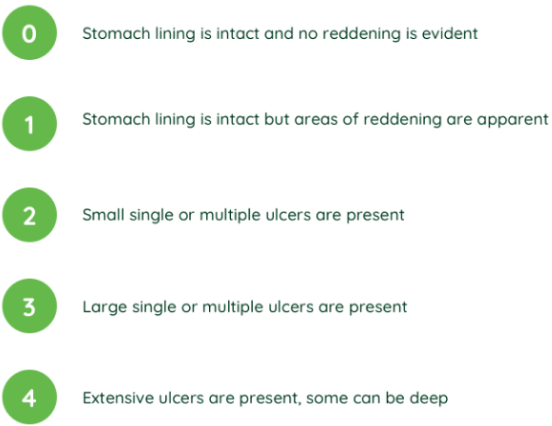
The grading system for ESGD is on a 0 to 4 scale with 4 being the most severe. The table below shows the definitions for each grade
Symptoms of gastric ulcers in horses
Symptoms are not always very easy to distinguish from other issues or diseases but some common ones include:
- weight loss
- dull coat
- biting when being girthed
- intermittent colic
The same symptoms can apply to both ESGD and EGGD as they both cause digestive discomfort. It is important to consider that good doers and those that look healthy on the outside can have ulcers too. It is also apparent that there is no link between the severity of ulcers and the symptoms – some horses are clearly very stoic and can have grade 4 ulcers with no obvious clinical signs.
Starch Intake Calculator
At Dengie all of our feeds are naturally low in starch but we are often asked about starch levels in other feeds and how to work out the amount of starch a horse is consuming each day. We have devised a simple tool that allows you to input the details relating to your horse’s diet. This is particularly important for horses prone to gastric ulcers as the recommendation is for the diet to contain less than 2g of starch per kg bodyweight per day and 1g per kg bodyweight per meal. You will need to gather some information about the feeds you are using to put into the calculator but at least you haven’t got to do the maths!
Starch Intake Calculator
At Dengie all of our feeds are naturally low in starch but we are often asked about starch levels in other feeds and how to work out the amount of starch a horse is consuming each day. We have devised a simple tool that allows you to input the details relating to your horse’s diet. This is particularly important for horses prone to gastric ulcers as the recommendation is for the diet to contain less than 2g of starch per kg bodyweight per day and 1g of starch per kg bodyweight per meal. We would always recommend feeding as little starch as possible to promote digestive health generally. It is possible to meet the energy requirements of most horses without needing to use cereal based feeds – please contact the Feedline for help and advice on how to do this. To use the calculator you will need to gather some information about the feeds you are using but at least you haven’t got to do the maths!
Using straw for horses with ulcers
Back in 2009, a study that looked at the incidence of gastric ulceration in a population of horses found that those that were fed straw as the sole or predominant fibre source were more likely to have ulcers. The reasons given related to the structure of straw and the fact that straw contains low levels of calcium and protein. This makes sense given that it is alfalfa’s naturally high protein and calcium levels that are thought to make it a superior buffer.
However, the key here is that straw was used as the sole or predominant fibre source which is not typically done in the UK. Recognising that straw can be useful as a low-calorie forage source for good doers, a follow up study has been published investigating the safety of feeding 50% wheat straw to replace haylage.
This study by Jansson et al (2021) found no ill effects and specifically looked for gastric ulcers. Some simple calculations show that if straw replaces 1/3 of the weight of an average hay, a reduction in energy intake of 16% is achieved. Obviously replacing half the haylage ration will achieve an even greater reduction.

Why feed the ulcer prone good do-er?
Whilst the mainstay of any horse’s diet should be forage, in the form of either fresh pasture, or conserved forage like hay or haylage, even good do-ers can benefit from a bucket feed for the following reasons:
To provide a balanced diet; UK pasture and forage lack a number of key trace minerals including copper, selenium and zinc as well as vitamin E in conserved forage. Topping up these nutrients helps to ensure a balanced diet is supplied. Most frequently this can be achieved by adding a broad-spectrum vitamin and mineral supplement or balancer to a low calorie chopped fibre feed to act as a carrier.
As a lower calorie alternative to hay; hay and haylage can easily supply more energy or calories than the good do-er in light work requires and so the amount fed may need to be restricted. Alternatively, it is possible to replace a proportion of the forage ration with something even lower calorie such as a low energy chopped fibre feed. Overall this may mean the horse can have a larger amount to eat which supports digestive health.
As a pre-exercise feed to reduce the risk of acid splash; whilst this could be hay or haylage, many people will be aware that research has shown that feeding alfalfa as a fibre source is a superior buffer in the digestive tract. Feeding a double handful of a chopped alfalfa-based fibre feed in the 20-25 minutes before you ride is recommended to help prevent ‘acid splash’ in the non-glandular region of your horse’s stomach. The fibre ensures the stomach isn’t empty and suppresses the movement of the acidic contents when the horse moves.
Forages for horses that aren’t good doers
The more stereotypical horse with ulcers is one that doesn’t hold weight and looks in poor condition. In these scenarios the key challenge is promoting weight gain without increasing starch intake. The first step to achieving this is to use as digestible a form of forage as possible and feed plenty of it.
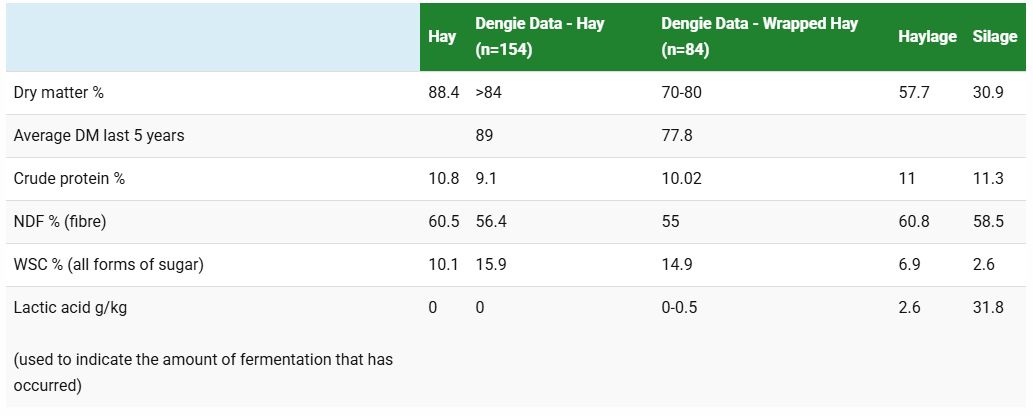
The concern about using a true haylage for horses with ulcers is that the fermentation process used to conserve the forage produces acids and feeding a forage with increased acidity levels would not be helpful in trying to manage EGUS. However, a more accurate description of many so-called haylages would be ‘wrapped hay’ as they are often very dry which has meant that little or no fermentation has occurred. This means the levels of acidity are no different to a normal hay which can be seen in table 2. A possible benefit of using wrapped hay is that it may well have been harvested earlier and so is likely to be more digestible meaning that the horse is likely to do better on it. Forages containing more moisture and cut earlier are often more palatable which is useful for poorer doers who may not have a big appetite. For poor doers, feeding forage to appetite is ideal as there is no reason to restrict them.
Table 2 – A comparison of different forages (data from Dengie analysis records and Muller and Uden (2007))
EGGD aetiology
The glandular region of the stomach contains glands that secrete hydrochloric acid, pepsin, bicarbonate and mucus. The stomach secretes acid continuously; as the horse is a trickle feeder it needs to continuously produce digestive compounds and it is important to note that this process continues even when the horse isn’t eating. The volume of secretion has been shown to be around 1.5l of gastric juice per hour although this does vary at different times during the day. The pH of the stomach contents ranges from 1.5 to 7 depending on location with the area at the oesophagus around 7 (neutral), which decreases to between 3 to 6 around the margo plicatus which is where the stomach tissue type changes and then down to 1.5 to 4 in the glandular region. Remember that a lower pH means the stomach is more acidic and so a pH below 4 in the squamous region contributes to an increased risk of ulceration occurring.
Risk factors for EGGD
A great review has been written by leading veterinary researcher Mike Hewetson of the RVC – click here to read it. Some key takeaways from this review are:
- Even if a horse has both ESGD and EGGD it doesn’t mean they are associated
- EGGD is likely to result from the breakdown of normal defence mechanisms that protect the stomach tissue ie the secretion of mucus.
- An increasing amount of evidence exists to suggest an association between stress and EGGD
- In Thoroughbred racehorses, the trainer has been identified to be a risk factor independent of other management factors
- EGGD was inversely correlated to the experience of the horse in both polo ponies and show jumpers which may suggest a degree of adaptation to physiological stress, differences in management of elite horses or selection for horses that do not develop EGGD.
- Exercise is also a risk factor – exercising more than 4 or 5 days per week was found to be a risk factor for EGGD in racing Thoroughbreds and showjumpers respectively
- In endurance horses, the prevalence of EGGD doubled during the competition season compared with the inter-season period
The link between stress and the incidence of EGGD is one reason why the problem is difficult to resolve. Removing the cause of stress can be difficult for performance horses as stress is inherent in their role, owners and trainers can therefore face difficult choices if EGGD persists.
Risk of Gastric Ulcers
There are lots of different factors that increase a horse’s risk of developing gastric ulcers. We have developed a questionnaire to help you ascertain your horse’s risk level.
It is a guide and is only as good as the information you put in so answer as honestly and accurately as you can. If your horse has a high score it doesn’t mean they will have ulcers and conversely, a low risk score doesn’t mean they won’t have ulcers. Having said that, a study published in Preventative Veterinary Medicine showed that using a similar questionnaire from the USA was relatively well correlated with the presence of ulcers.
The aim of the questionnaire is just to highlight some of the management practices that increase the risk of ulcers and that you may want to change if you can – especially if your horse has a high risk. This questionnaire is not an alternative to, or replacement for, seeking the advice of a qualified vet.
If you have any queries about the questionnaire please don’t hesitate to contact the Dengie Feedline on 01621 737088 or visit our contact page to get in touch.
Managing a horse with EGGD
Whilst there is no evidence-based link between diet and EGGD, the advice is still to implement the same feeding management as for ESGD which amounts to reducing starch intake and feeding plenty of fibre. More crucially, trying to minimise stress by ensuring continuity of carer and reviewing any practices on the yard that may be distressing the horse are key. Providing at least 2 rest days a week are also recommend.
What ingredients are good for horses with ulcers?
The most important requirement is that an ingredient should be low in starch. This tends to mean that ingredients high in fibre and/or oil are most popularly used. There are published studies to support the use of ingredients such as alfalfa and sugar beet for horses with ulcers. Studies back in the early 2000s (Nadeau et al, 2000; Lybbert et al, 2007) showed that alfalfa was more beneficial for horses with ulcers (ESGD) compared to grass forages, as the high levels of calcium and magnesium it contains act as natural buffers to acidity. More recently studies carried out by the Lab to Field research group based in Dijon, France have shown the protective effects of alfalfa in horses in training. Their findings demonstrated that clinical success with horses with EGGD was 47.7 times more likely in horses fed alfalfa pellets as part of their ration compared to those on concentrate only rations.
A study published in 2024 showed that a combination of alfalfa, sugar beet and oat fibre aided reduction in recurrence of gastric ulcers when fed during the healing and post-medication periods in addition to the usual ration. This is key for when ulcer medication is stopped and the rebound increase in acid production can occur (Menzies-Gow and Shurlock, 2024).
So what can we conclude about feeding alfalfa to horses with EGUS?
- There have been no negative effects in the squamous region of the stomach in horses of any age from feeding alfalfa
- The only group where an effect with alfalfa chaff has been seen is weaned foals but it was fed at much higher levels than is typically done – there were no issues associated with feeding alfalfa pellets which would still provide some natural buffering from the calcium they contain
- Alfalfa chaff or chop is widely considered beneficial for adult horses at risk of or prone to EGUS due to its natural buffering potential
Summary
- ESGD and EGGD are very different diseases and even when concurrent may not be related
- ESGD risk factors are well established and include too little fibre, too much starch and exercising on an empty stomach
- Feeding at least 1.5% of bodyweight on a dry matter basis is the minimum amount of forage required for long term gastric and digestive health
- Feed a lower nutritional value forage so you can feed 1.5% of bodyweight without resulting in excessive weight gain
- Straw is a safe ingredient to use at up to 50% of the forage ration
- Wrapped hays that have not fermented and so are no more acidic than hay are also appropriate to use for horses with ulcers
- EGGD is still not fully understood but increasingly it is acknowledged by researchers that stress is a key contributing factor
- Alfalfa is safe to use for all horses with ESGD and adult horses with EGGD. One study suggests a possible increase risk for foals who were fed much bigger amounts than is typically done – if concerned use alfalfa pellets for their natural buffering benefits
- Studies have shown alfalfa to be beneficial as an alternative energy source compared to cereals for horses in training
References
- Bauerlein et al (2020) Effects of feeding alfalfa hay in comparison to meadow hay on the gastric mucosa in adult Warmblood horses. Pferdeheilkunde – Equine Medicine 36.
- Dugdale et al (2010) Effect of dietary restriction on body condition, composition and welfare of overweight and obese pony mares. Equine Veterinary Journal, 42 (7) 600-610.
- Jansson et al (2021) Straw as an Alternative to Grass Forage in Horses—Effects on Post-Prandial Metabolic Profile, Energy Intake, Behaviour and Gastric Ulceration. Animals. 11.
- Julliand et al (2023) Effect of diet composition on glandular gastric disease in horses. Journal of Veterinary Internal Medicine
- Lybbert et al (2007), Proceedings of Annual Convention of the AAEP, Orlando, Florida, 2007.
- Martin et al (2023) Effect of high-starch or high-fibre diets on the energy metabolism and physical performance of horses during an 8-week training period. Front. Physiol. 14:1213032. doi: 10.3389/fphys.2023.1213032
- Menzies-Gow and Shurlock (2024) The effect of feeding a commercial feedstuff on equine gastric squamous disease. Journal of Equine Veterinary Science. 133.
- Morgan et al (2016) Treatment of Equine Metabolic Syndrome: A clinical case series. Equine Veterinary Journal. 48. 422-426.
- Nadeau et al (2000) Evaluation of diet as a cause of gastric ulcers in horses. American Journal of Veterinary Research. Jul;61(7):784-90.
- Pratt et al, (2022) Assessment of agreement using the equine glandular gastric disease grading system in 84 cases. Veterinary Medicine Science, 8 (4) 1472-1477doi: 10.1002/vms3.807
- Rendle et al (2020) Tackling obesity and related laminitis in equine patients. Veterinary Times Equine, 6 (1) 6-9.
- Swanhall et al (2018) Mineral and Vitamin Supplementation Including Marine Derived Calcium Increases Bone Density in Thoroughbreds. Proceedings of the Australasian Equine Science Symposium



Expert advice at your fingertips
If you’re looking for advice on the best feed, speak to one of our highly experienced nutritionists on our feedline, or for a more in-depth plan, fill out our Feed Advice Form