


Nutritional Analysis
What should horse owners be looking for?
There are so many different horse feeds on the market nowadays, so it’s not uncommon for horse owners to be unsure which ones are best suited to their horse. Looking at the product name and description on the bag or on the manufacturer’s website is usually a good place to start, but what else do we need to consider when it comes to the nutritional contents of the feed?
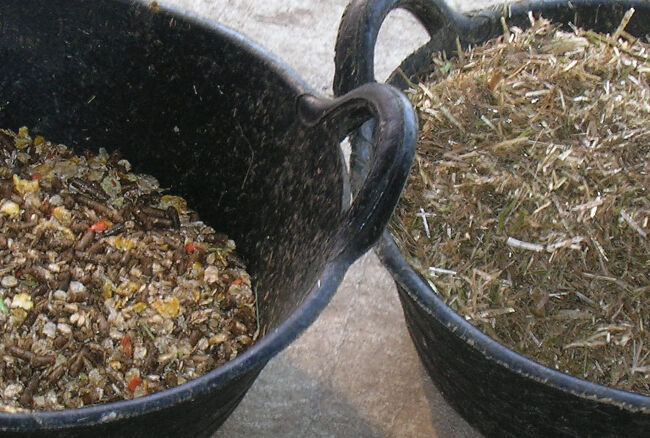
Energy is not technically a nutrient, but is released when food is broken down. Two measurements are used: calorie is the ‘old money’ term (expressed as kcal on food labels) and joule is the decimal system (expressed as MJ, or mega joules in horse feed). We all tend to think of calories as the measure of how fattening a feed is – not many of us talk about a ‘joule-controlled diet’ – but both measure energy, just as miles and kilometres both measure distance.
Sources of energy in horse feed
- Fibre should be the main source of energy for the horse and the most abundant fibre type is cellulose, which makes up between 20 and 40% of the dry matter of plants. Cellulose consists of linked glucose molecules that the digestive enzymes in horses are unable to break down. Instead, they rely on bacteria and other microbes to break down cellulose and other fibre types to release energy, which the animal can then utilise. Their digestive systems have developed to slow the speed that the food passes through, which allows microbes sufficient time to break down the fibre. Fibre is therefore considered a ‘slow-release’ energy source.
- Starch is also made up of glucose, but the molecules are joined together in such a way that the horse’s own digestive enzymes can break them down to release the energy. This happens in the foregut, so energy is released more quickly than with fibre. This is therefore why cereals, which contain lots of starch, provide the horse with quick-release energy relative to fibre.
- Fats and oils also provide energy, and these are considered a slow-release energy source. Fats and oils are energy-dense, containing 2.25 times more energy than carbohydrates, so feeds with a high oil content can be very conditioning.
Click here for more information on feeding the lazy or fizzy horse.
Why isn’t the energy level listed on horse feed bags?
Not all nutrient levels have to be declared by the manufacturer, and there are other regulations regarding labelling that companies have to adhere to. One of these is that energy mustn’t be listed in the statutory statement on the feed bags. This is because there is no official calculation for measuring energy for horses. Calculations developed for other species have been used for many years because they are the next best option, so many manufacturers choose to put this information elsewhere on the bag or list it on their website instead, where it will usually be referred to as ‘digestible energy’ or DE. Most manufacturers will also be happy to provide these levels on request.
Generally speaking, a feed classed as ‘low energy’ will have a DE level of 5-10 MJ/kg, and a ‘high energy’ feed will be 12MJ/kg and above. However, it’s also important to take into account the feeding rate when considering a product’s energy value, as this will impact on the amount of energy provided to the horse. This is shown in the examples in the table below.

Contact our nutrition team if you have any questions about the energy content of your horse’s feed.

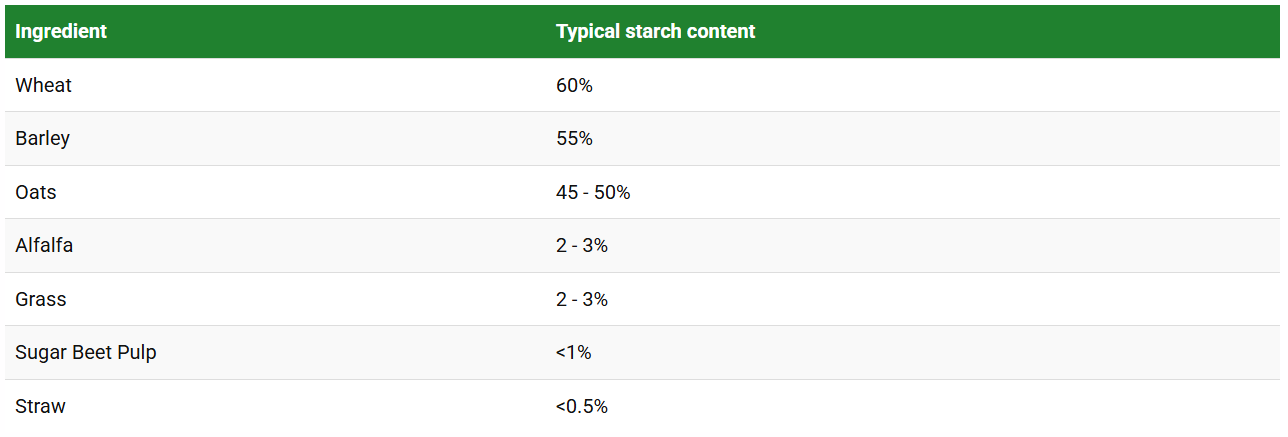
Starch is a carbohydrate and is the storage form of energy for plants. Plants store varying amounts of starch, and it is generally found in much higher concentrations in the seeds or grains of cereal plants. The table below shows some ingredients commonly used in horse feed and the levels of starch they typically contain.
Why do we feed starch to horses?
Traditionally, starch in horse feed has provided a concentrated source of energy that horses find very palatable. Horses that are working very hard have higher energy demands, and, as forage has a low energy density, a lot of forage would have to be consumed to meet the horse’s needs. There are ways around this, like using pelleted forms of high-quality fibre such as alfalfa pellets, and by adding oil to the fibre feeds. These options are becoming more popular alternatives to cereals. In fact, recent studies have shown that even high level competition horses can be sustained on rations using hay and alfalfa with only a very small proportion of cereals without any detriment to performance and muscle tone (Martin et al., 2023).
Starch is broken down in the horse’s small intestine to the simple sugar glucose. When produced in excess of the horse’s immediate energy requirements, glucose is stored as glycogen in the horse’s muscles and liver. Having a sufficient store of glycogen is particularly important for the performance horse, like the racehorse, as when they are working at fast speeds, their body uses its anaerobic metabolism to break down glycogen to glucose to use for energy. Insufficient glycogen stores will limit performance and result in fatigue. Starch from cereal grains tops up the horse’s glycogen stores faster than other energy sources such as fibre, which may be particularly significant for horses that are competing with little rest time between competitions. It is interesting to note that compared to humans, horses are quite slow at replenishing their glycogen stores, regardless of the energy source.
Why do we need to consider a low starch diet for horses?
Firstly, as the amount of cereal-based feed in the diet increases, typically the amount of fibre offered or consumed decreases. Fibre is vital for the maintenance of digestive health, and digestive disturbances, such as gastric ulcers and colic, are more likely to be experienced in horses on a low fibre, high starch diet. Secondly, horses have a limited capacity to digest starch in their small intestine. Starch escaping digestion in the small intestine ends up in the horse’s hindgut where it is rapidly fermented. This results in a more acidic environment and a change in the intestinal microbiota. This change has also been linked to an increased risk of colic, laminitis and behavioural changes.
When feeding starch to horses we therefore need to be mindful of the amount used and consider whether we actually need to feed cereal-based concentrates at all. If too much starch is fed, then the risk of digestive disturbance increases. Current advice is to restrict starch intake to less than 1g of starch per kilogram of bodyweight per meal and less than 2g of starch per kilogram of bodyweight per day.
What’s the alternative to starch for horses?
How can we strike a balance for hard working horses that have high energy demands between meeting their energy needs whilst looking after their digestive health? As a starting point, using more digestible sources of fibre, such as an early cut haylage, alfalfa and sugar beet, can provide significantly more energy than less digestible fibre sources like a late cut hay. Oil is also a useful addition to the ration as it is very energy dense. Only then, if energy demands cannot be met as the horse is working very hard with limited rest between competitions, should a high starch feed be considered, though care should be taken not to exceed recommended levels.
Sugar in horse feed
A lot of myths and misinformation circulate about sugar which leads to confusion about what sugar is, where it comes from and which feeds are suitable for different types of horse and pony. The first key fact to be aware of is that grass and grass-based forages are the greatest source of sugar in most horse’s rations. The table below highlights the levels of water soluble carbohydrate (WSC) provided in a ration that is typical for a good doer. WSC includes simple and storage forms of sugar. It is important to note this is not a balanced diet as too little of the Pony Cubes is being fed to supply the correct levels of vitamins and minerals but it is, nonetheless, a common approach. By far the biggest source of WSC is the hay. Even if a lower WSC hay is used, it is still going to be the greatest source of sugar in the ration.

Sugar levels in forage
The level of sugar in grass will vary according to a number of variables such as:
- Time of day
- Season
- Weather conditions
- Grass species
The level of sugar is usually highest in the afternoon of bright sunny days when the plants have been photosynthesising for longest. This is why it is recommended to turn those at risk of laminitis out overnight and bring in by mid-morning at the latest.
How much sugar is safe for your horse will depend on your horse’s condition and physiological status. It is recommended that horses that are overweight, suffering with insulin dysregulation, prone to laminitis or with PPID should be fed less than 10% non-structural carbohydrate (NSC) in the total diet. NSC is the total amount of simple sugar, storage sugar and starch. This would effectively mean very little, if any, pasture can be consumed and a mature, highly fibrous forage should be used. Finding a low sugar hay for horses can be very difficult and although some types of grass, such as timothy, tend to be lower in sugar, it isn’t always the case.
Sugar free horse feeds – do they exist?
Most fibrous materials, including straw, contain some sugar and so sugar free feeds don’t exist. ‘No added sugar’ is a more accurate term and in the context of chopped fibre feeds, this means the fibre either has no coating added at all or an oil coating has been used which doesn’t contribute any sugar. The base ingredients will naturally contain some sugar. Some supplements may be sugar free if they don’t contain any plant material, but these are very much supplements and not feeds. For horses needing a low sugar diet, remember to also make sure the starch level in the chosen feed is low as well.
Sugar analysis and declarations
Analysing forage is recommended when seeking low sugar feeds for horses, but the results are only as good as the sampling methods used. Taking samples from a selection of bales is the best way to get a better impression of the sugar levels in a forage, but it isn’t always possible to do so. In these situations, the analysis is giving an indication or a guide and it is worth taking samples on a number of occasions if it is only possible to sample one bale at a time.
Feeds that are based on cereals are most likely to declare a simple sugar level as they don’t typically contain a high proportion of grass, and so analysing for WSC is less relevant. The sugar analysis will pick up simple sugars from ingredients like molasses. When it comes to chopped fibres and other high fibre feeds, then WSC is a useful value to have, especially if the feed contains dried grass. If a company gives a sugar value on a grass-based fibre feed, it is worth contacting them to be sure if they have also analysed WSC as this will likely present a very different picture to a simple sugar value.
Inevitably there will be some variation in levels for every product no matter who produces it. A difference of 1- 2% in declared levels between products makes very little difference as the actual level in the bag could easily vary that much between batches. Choosing feeds that are well below the 10-12% NSC recommended for horses and ponies prone to laminitis is therefore key.

What is molasses used for and is it too high in sugar?
Molasses is primarily used to naturally sweeten feeds to enhance their palatability, and this sweetness comes from its sugar content. The forms of sugar found in molasses are also found in grass so we shouldn’t view the sugar in molasses as unnatural. What matters is how much is fed in total and how much is consumed at one time. To put this into perspective, as a guide, 7.5kg of hay (on a dry matter basis), the minimum recommended daily amount for a 500kg horse, would typically supply around 650-850g of sugar. To supply the same total amount of sugar from molasses, it would be necessary to feed over 1kg of pure molasses. Clearly this is never likely to be done intentionally! In reality, molasses is added at very low levels to feeds which are then fed in much smaller quantities than grass-based forages and so the actual amount of sugar supplied from molasses is very low. Click here for more information about molasses and why it is used.

Why do horses need protein?
Protein is often cast as the villain, but it is actually vital for good health in your horse. Protein is found in all tissues in the body, and enzymes, hormones and antibodies are also made of protein. The building blocks of protein are amino acids, some of which have to be supplied in the diet because the body cannot make sufficient quantities to meet requirements. The amino acids that must be supplied in the diet are termed essential amino acids for horses. The ‘quality’ of a protein is often measured by the levels of essential amino acids it contains. Lysine is the only amino acid for horses, essential or otherwise, for which the requirement has been determined.
What is lysine and why do horses need it?
Lysine is an essential amino acid which means that it must be supplied in the diet. Lysine is known as a limiting amino acid. This means that whilst there can generally be an abundant amount of protein in the diet, the horse can still be protein deficient if there is insufficient lysine in the diet. Lysine is particularly important for youngstock because a deficiency will limit growth and development.
Signs of protein deficiency in horses
Generally, if enough energy is consumed, which can be identified by the horse being in good body condition, the overall amount of protein in the diet is likely to be sufficient as well. However, despite an adequate protein intake, it is possible for a horse to still be lacking sufficient essential amino acids for horses, like lysine. This is most likely to occur in horses that have restricted grazing and forage, or possibly even for horses having soaked forage. It can also occur at times of higher demand coupled with inappropriate nutrition, such as during pregnancy, lactation and growth.
Easy-to-spot symptoms of protein deficiency in horses include:
- Poor hoof growth
- Poor hair quality
- Loss of muscle mass
- Poor growth in youngsters (as identified by lower than average daily gain)
- Reduced milk production in lactating mares
Ingredients such as alfalfa can be a useful way of elevating your horse’s protein intake.
Myth Busting: Isn’t too much protein bad for horses?
It has taken some time, but there is now fairly extensive research vindicating protein, which raises the question: why was protein ever thought to be the cause of so many problems? The explanation might well lie with the laws governing the nutritional information that has to be listed on every bag of horse feed.
As the level of protein has to be declared on a bag of feed and the starch level doesn’t, protein has often been used as the measure of the ‘richness’ of a feed. With traditional cereal-based compound feeds such as mixes and cubes, it usually follows that the higher the protein level, the higher the starch level, as the feed is designed for horses in higher levels of work and so supplies more energy from starch. If high protein (and starch) feeds are being fed and a problem such as laminitis or colic ensues, it is fairly understandable that protein is believed to be the cause because this is the nutrient that the horse owner knows has increased when they look at the back of the bag. Until changes to legislation are made, it is likely that some horse owners will continue to blame protein for a number of problems.
Where can I go for more information?
More information on the different ingredients used in horse feeds and what they provide can be found here.



Expert advice at your fingertips
If you’re looking for advice on the best feed, speak to one of our highly experienced nutritionists on our feedline, or for a more in-depth plan, fill out our Feed Advice Form