


Feeding the Leisure Horse
Feeding your horse can seem like a minefield, but one mantra that every horse owner should start with is “feed according to your horse’s bodyweight and workload”. Whilst this sounds simple in practice, how do you know how hard you are working your horse and what their requirements are?
What is my horse’s workload?
Horse feed manufacturers typically simplify workload into four categories when helping you to decide if a feed is appropriate for your horse – maintenance, light, medium and hard work.
- Maintenance: Horses at rest or those that are not taking part in any ridden or enforced exercise such as those that are retired.
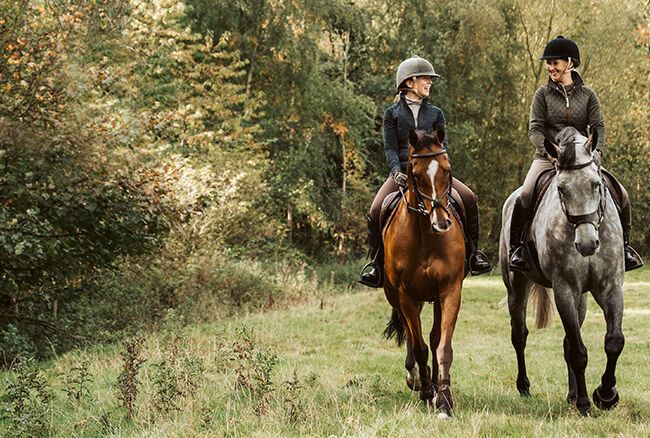
- Light work: Generally this includes light hacking and schooling, mostly at walk and trot with some canter. Local, unaffiliated competitions are probably only light work for most horses and ponies.
- Medium work: Usually includes regular schooling for around an hour a day and competing in affiliated competitions.
- Hard work: These horses will be competing at higher levels and their training and schooling reflects this. Eventers and racehorses will do more faster work in their training whereas dressage horses work harder to do more advanced movements. Show jumpers often compete very frequently and the rigours of travel may also increase the horse’s energy and nutrient requirements.
It’s important not to overestimate your horse’s workload when considering feed type and daily quantity, as feeding a higher energy feed for a horse in lower levels of work may result in excess weight gain. It can be helpful to speak to your feed manufacturer or a nutritionist for further guidance on suitable feeding rates for your horse if you are unsure.
The energy requirements of horses at rest are simply to support their normal bodily functions and to maintain weight. Horses on box rest or recovering from illness or injury may need further support, and more information on feeding these horses can be found here.
Many horses at rest will easily maintain their weight on grazing and forage alone. They are unlikely to need a significant amount of bucket feed in order to supply additional energy or calories, but it is important to remember that UK pasture and forage typically lack certain trace minerals. Pasture is usually lacking in copper, selenium and zinc, and conserved forages like hay or haylage can be short of vitamin E as well, particularly as it ages. Horses at maintenance should therefore be offered a balancer or vitamin and mineral supplement combined with a low-energy chopped fibre feed, such as Dengie Hi-Fi Lite, to top up on these nutrients. More information on feeding a balanced diet can be found here.
Retired horses and ponies who are maintaining their weights well may not need any specific dietary changes just because they are getting older, but for individuals with PPID or dental problems, certain adjustments may be required. More information on feeding the senior horse or pony can be found here.

In practice, the need to add a supplementary feed as workload increases really depends on how well your horse maintains their weight. Energy and calories are essentially the same thing, so the easiest way to determine whether your horse has a sufficient energy intake is to assess their body condition score. As a guide, a condition score of 3 on the 5 point scale is about right for most leisure horses. It doesn’t matter how hard they are working, if they are overweight then they don’t need more energy!
Good doers in light work may simply require a ration that’s similar to those at maintenance. For those that don’t hold their weight quite as easily, using feeds higher in fibre and oil will provide slow-release energy, helping to reduce the chance of over-exuberant behaviour.

Many feeds targeted at horses in medium or harder levels of work will contain an increasing level of starch. However, when it comes to supporting digestive health and providing slow-release energy, it can be preferable to choose feeds that include more digestible fibre sources such as alfalfa and sugar beet pulp, or higher levels of oil, such as Dengie Alfa-A Oil, Alfa-Beet, Alfa-A Molasses Free or Meadow Grass with Herbs & Oil. It’s important to continue to monitor the horse’s body condition score though and remember that even those in higher levels of work can still be good doers or overweight. For these horses, using a suitable balancer for their level of work alongside a good quality chopped fibre can work really well. More information on feeding the performance horse can be found here.
Help! My Horse Needs More Energy – Feeding the Lazy Horse
If your horse’s lack of energy is out of character, it is essential to firstly establish if there is an underlying cause, such as ill health or pain and discomfort from ill-fitting tack. Considering your horse’s level of fitness is also key; for example, horses who have been in less work over the winter months when daylight hours are reduced may need more time to re-build fitness once the clocks change in the spring. Being honest with yourself and assessing your horse’s capability to do the work being asked of them is really important.
Additionally, consider if your horse’s lack of energy could relate to their natural behaviour rather than the diet. Some horses are inherently laid-back characters and others may become ‘bored’ with repetition. Feeding is unlikely to influence your horse’s behaviour in these situations, but sometimes rider training and a more varied exercise regime can be helpful.
Although a change of diet might not completely solve the problem, sometimes assessing and making some adjustments to your horse’s ration can be of use. The two fundamental points to consider are whether your horse is receiving enough dietary energy and whether they are having a balanced diet with the correct levels of vitamins and minerals.
Body condition scoring is a really good way to identify if the horse is consuming sufficient energy for the work they are doing. A horse that is above 3 on the 5 point scale will be receiving excessive amounts of energy or calories and is carrying too much weight. Encouraging weight loss by reducing their energy (calorie) intake will be beneficial not just for their overall health but may also help to support energy levels as they may feel better in themselves. More information on feeding the good doer can be found here.
A horse that is well below 3 on the body condition score scale is probably receiving insufficient amounts of energy or calories in their ration. Increasing their overall energy intake to promote weight gain and achieving an optimal body condition may help to improve their energy levels for exercise. More information on feeding the poor doer can be found here.
Horses with a moderate body condition are likely to be receiving an appropriate amount of energy in the diet for the work being done, and increasing energy intake any further could just result in weight gain. At this stage, looking at the type of energy being supplied may be the next step. Fibre and oil provide slow release energy whereas sugar and starch provide quick release energy. For lazy horses where more sparkle is required, cereal grains are commonly fed as they provide lots of starch and therefore quick release energy. However, there is no guarantee that the introduction of cereal grains will have a positive effect on your horse’s behaviour. It may have no effect at all, or it may result in spooky, silly behaviour rather than helping them to be more forward-going. Research has found that horses fed a cereal-based concentrate mix were more reactive to new situations and equipment than those on a high fibre and oil diet (Bulmer et al., 2015). They were less consistent in their behaviour and had higher heart rates compared with horses fed the fibre-based feed.
As too much starch can also contribute to problems such as colic and gastric ulcers, it is important that cereals are used in moderation. They should always be introduced gradually, literally a handful at a time, to give the digestive system time to adjust to the new feed. Oats tend to be the cereal most commonly used to try and give horses more energy, as they are the most easily digestible. Feeding cereals to an overweight horse would not be beneficial as it is likely to encourage further weight gain which will compound the problem of lethargy further.
For horses needing more stamina then feeding additional oil may be of benefit, which is why relatively high levels of oil are commonly used for endurance horses (Treiber et al., 2008). The oil content of the ration can be easily increased by introducing high oil feeds such as Dengie Alfa-A Oil, but bear in mind that high oil feeds are high in calories so are not an appropriate choice for good doers or those who are carrying too much weight.
The other key point to consider when it comes to supporting energy levels is to ensure the horse is receiving a fully balanced ration. Vitamins and minerals are involved in energy metabolism and are often missing from the diet of good doers who are frequently on restricted rations. A shortfall of vitamins and minerals in the diet can therefore affect energy levels for exercise. If you are feeding the recommended quantities of a compound feed or balancer that is intended for the level and type of work your horse is doing, alongside sufficient forage, the diet should be well-balanced, but it’s always worth speaking to a nutritionist if you’re unsure.
It’s also important to remember that electrolytes aren’t just for performance horses – if your horse is sweating a lot when working, which is often the case for those that are a bit overweight, they will be losing electrolytes which can result in fatigue. For this reason, horses who sweat when exercised or when travelling will benefit from an additional electrolyte supplement as part of their diet.
Help! My Horse is too Fizzy – Feeding the Fizzy Horse
The term “fizzy” is usually applied to horses and ponies that display over-exuberant behaviour when being ridden. This can be seen as them wanting to go everywhere at a faster speed than the rider, who, when they try to restrain the horse, is rewarded with jogging and possibly spooking, bucking and rearing. Ultimately, it usually means that the rider is worn out trying to keep the horse under control and fizzy behaviour can be detrimental to performance. There are a number of factors that can result in fizzy behaviour and it is important to explore all possibilities, including feeding.
Firstly, it’s important to ensure the horse isn’t in pain when being ridden, as poorly fitting tack, dental problems or underlying injuries may affect how the horse feels when they are being ridden and may be influencing their behaviour. A thorough examination of the horse and the tack should be carried out by experienced professionals to ensure that pain isn’t the cause of the problem.
The environment is often a contributing factor, with windy days increasing the chance of even the calmest horse shying away from a plastic bag in the hedge. Excitement generated by being in a different environment, such as away at a show or out on a hack, can also be the cause of many problems.
Limited exercise and stabling for long periods are also common reasons for a horse to exhibit fizzy behaviour. If this is the case, addressing the underlying issue by turning out for longer or increasing the amount of exercise is usually the most effective way of solving the problem. However, this isn’t always possible, so ensuring that the diet is based on slow-release energy sources with fibre-based feeds, rather than quick-release energy sources, is a good place to start.
There are two areas to consider when feeding fizzy horses – the amount of energy being consumed and the type of energy supplied within the ration. Providing more energy than your horse needs can result in over-exuberant behaviour and weight gain, so the horse’s body condition score should be assessed when managing energy intake. In spring and summer, the longer evenings and generally better weather mean that we tend to increase our horse’s workload gradually. Horses who are generally looking and feeling well do not necessarily need an increase in feed or energy intake to coincide with an increasing workload, so it’s advisable to continue to monitor their bodyweight and how they’re feeling to determine if a higher energy ration is necessary.
For horses who are gaining too much weight, consider whether their energy intake from their bucket feed can be reduced at all whilst still providing a balanced diet. For example, feeding a balancer alongside a low energy chopped fibre feed can be a great choice for the fizzy good doer. The season should also be considered – remember that grass growth begins in earnest in the spring, so it will make more of a contribution to your horse’s ration and therefore their overall energy intake at this time of year.
For fizzy horses and ponies who do need some energy in their diets to maintain their weight, the ration should be comprised of slow-release energy sources, like fibre and oil, rather than quick-release energy sources like cereals that are high in starch.
Starch and sugar are rapidly broken down in the horse’s digestive system, releasing energy quickly. The main source of starch commonly used in horse feeds tends to be cereal grains. Starch is rapidly broken down to glucose, which passes from the digestive system into the bloodstream. The resulting peak in blood glucose is thought to be why fizzy behaviour follows, so keeping starch intake to a minimum is essential.
It might surprise you to learn that the most abundant source of sugar in the horse’s diet is grass, so other sources of sugar that are fed in much smaller quantities – such as molasses – shouldn’t always be assumed to be the cause of fizzy behaviour. An increased intake of sugar, such as when the horse consumes a lot of fresh spring grass, can result in more over-exuberant behaviour. Many people are surprised to learn every kilogram of grass in the spring can supply about 400g of sugar! This is much higher than in hay, at around 100g of sugar per kilogram, and Dengie Hi-Fi Molasses Free at just 25g of sugar per kilogram. It’s easy to see why horses at grass are likely to consume around 4kg of sugar very easily every day from grass alone – that’s equivalent to four bags of sugar from the supermarket!
In contrast, sources of slow-release energy are those based on fibre and oil, which are broken down slowly in the horse’s digestive system so there is not the associated large peak in blood glucose which would be seen with starches and sugars. Many people underestimate just how much slow-release energy good-quality fibre can contribute to the ration, although this will be dependent on the source of the fibre in the diet.
For example, straw is very fibrous and therefore not very digestible. This makes straw very useful for horses and ponies that maintain their weight well but, for those who struggle to maintain weight, a more digestible fibre source such as alfalfa or unmolassed sugar beet would be more valuable. Alfalfa naturally has a similar energy or calorie level to a cool or pasture mix, but with about 10 times less starch, which means that you can feed a fibre-based feed and still meet the energy requirements for most horses and ponies.
Oil contains lots of energy or calories and is a useful way of increasing the horse’s energy intake as a safer alternative to cereals for horses and ponies prone to laminitis or muscle problems such as PSSM. Oil provides slow-release energy, so it is ideal for fizzy horses who require additional energy to maintain their weight and condition. More information on different feed ingredients can be found here.
Fizzy horses can sometimes also be quite anxious individuals, which may cause loose droppings at times of stress. These horses also tend to lose weight easily. In these situations, a more comprehensive digestive supplement may be beneficial. Products that combine a prebiotic and yeast will help to maintain a healthy digestive system at times of stress. They can be used long-term but might also be effective when used for a few days before, during and after a period of stress.
Because fibre and oil provide slow-release energy, they should form the basis of the ration for fizzy horses and ponies. For those in light work who are good doers, Dengie Hi-Fi Molasses Free, alongside a broad-spectrum vitamin and mineral supplement or feed balancer, would provide a balanced high-fibre bucket feed that is low in starch, sugar and energy. For horses needing to put on weight and condition, Dengie Alfa-A Molasses Free or Alfa-A Oil, again fed alongside a balancer, would be suitable. Unmolassed sugar beet pulp can also be a good option. Because alfalfa and sugar beet pulp both provide slow-release energy, Dengie Alfa-Beet, which combines both without any other additives or molasses, is another way of increasing the energy intake whilst keeping starch and sugar levels down.
Summary
- Make sure you’re not over-feeding for the amount of work being done – studies have shown that horse owners tend to overestimate how hard their horse is working and so the temptation is to feed too much.
- Assess your horse’s body condition score to identify if they are receiving sufficient dietary energy for their needs, and remember that feed doesn’t always need to be increased with increasing work.
- Ensure the diet is balanced by feeding recommended quantities of a fortified feed, balancer or vitamin and mineral supplement, alongside sufficient forage.
- For the lazy horse, remember that being overweight will also make exercise more challenging – achieving a healthy bodyweight can play a key role in supporting energy levels.
- Don’t mistake a lack of fitness for laziness – if you’re asking your horse to perform a level of work that they aren’t fit enough to do, they are probably going to struggle.
- For fizzy horses who find it difficult to maintain their weight, it is important to consider the type of energy within the diet – sugar and starch provide horses with quick release energy whereas fibre and oil are slow release energy sources.
References
- Treiber et al., (2008) Dietary energy source affects glucose kinetics in trained Arabian geldings at rest and during endurance exercise. The Journal of Nutrition, 138(5), pp.964-970.
- Bulmer et al., (2015) The effects of a high-starch or high-fibre diet on equine reactivity and handling behaviour. Applied Animal Behaviour Science, 165, pp.95-102.



Expert advice at your fingertips
If you’re looking for advice on the best feed, speak to one of our highly experienced nutritionists on our feedline, or for a more in-depth plan, fill out our Feed Advice Form