

Mallanders and Sallanders in Horses
What are feather mites?
Chorioptic Mange is caused by the feather mites Chorioptes equi that live on the surface layer of the horse’s skin. They are only about 0.3mm in size so can’t be easily seen by the naked eye. The mites in horses feed on the skin debris and can live for around 70 days after hatching from eggs laid on the surface of the horse’s skin. The lower legs are the most common place for the mites on horses to live and although feathered horse breeds seem to be most affected, they can be found in any breed of horse or pony.
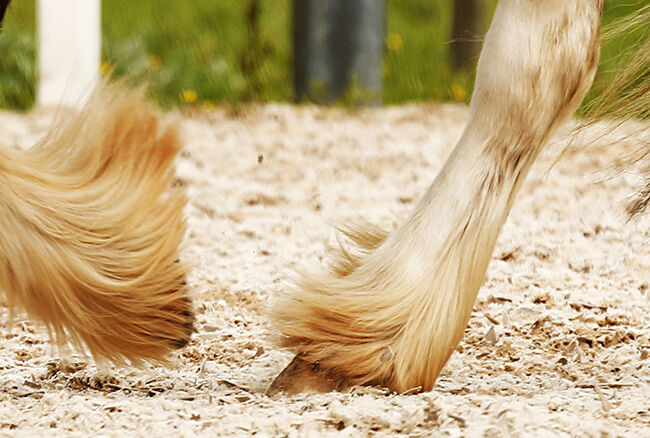
Itching, stamping and rubbing are all common symptoms of mites in horses, which are caused by the irritation of the mites feeding and crawling on the horse’s skin.
Scurfy, flakey skin is another common symptom of chorioptic mange and is believed to be the skin’s natural defence to shedding the mites. Often, even when the mites have gone, the horse’s skin continues to flake
Chorioptic mange can be treated but it is difficult to get rid of it completely due to the mites living in the environment or on other horses thereby causing re-infection. This means regular feather mite treatment is often required. Complete elimination of mites is likely to require treating all the horses on the property at the same time as well as disinfecting all the stables and other communal areas.
Ivermectin and Doramectin, both active ingredients in wormers, as well as Fipronil which is in flea products, are all options for horse mites treatment. Pig oil and sulphur is a traditional feather mite treatment which may also help. Clipping feathers off can help with applying horse mites treatment but is unlikely to resolve the issue on its own.
What is mallanders and sallanders?
Occasionally, large crusty areas can form at the back of the horse’s knees which are know as mallanders or the front of the hocks known as sallanders. The thickening of the skin leads to scaling and a dandruffy appearance. Unfortunately, once these thickenings have formed it’s difficult to get rid of them and they are unlikely to ever totally go away.
Mallanders and Sallanders is linked to current or historic mites issues in heavy and feathered breeds of horses and so should be checked for regularly. Unfortunately, these breeds are particularly prone to them as hyperkeratinisation is also associated with having feathers.
Hyperkeratosis is a thickening of the outer layers of the skin triggered by the movement of the mites causing inflammation and in some cases infection. In a normal situation, the epithelial cells shed regularly but in hyperkeratinisation, excess keratin is formed and accumulates causing the normal shedding process to be disrupted. Keratin is a fibrous protein that is the main structure of the skin, hair, hooves etc and is produced by epithelial cells. Keratin is also essential for wound healing.

Mallanders and sallenders treatment
Often, attempts to remove the mallanders and sallanders in horses can do more harm than good. Usually, they are just unsightly but in some more extreme cases, they can become infected. Trying to keep them soft by using aqueous based creams can be beneficial if they are prone to becoming chapped.
Link to nutrition
Although nutrition and diet are frequently discussed on forums and linked to mallanders and sallanders in horses, there isn’t any scientific evidence to support this information. For example, there is often talk, particularly on social media, of biotin making mallanders and sallenders worse. However, there is no scientific evidence to support this. Biotin is a naturally occurring vitamin present at low levels in grass and forages and is produced internally by the horse itself as it breaks down fibre. It is therefore impossible to provide a diet which is completely free from biotin.
In fact, as hyperkeratosis is most commonly caused by mites, biotin supplementation will not worsen this condition, but a deficiency in biotin may do so. A study in chickens found that hyperkeratosis was a direct effect of biotin deficiency in humans has been found to lead to brittle nails, inflamed skin and weaker hair.
From a diet and nutrition perspective, supplying a balanced diet that provides adequate good quality protein plus vitamins and minerals are all important for general skin health and support. In addition, a small amount of a high quality oil rich in essential fatty acids such as omega 3, can also help skin health and suppleness.



Expert advice at your fingertips
If you’re looking for advice on the best feed, speak to one of our highly experienced nutritionists on our feedline, or for a more in-depth plan, fill out our Feed Advice Form