


Reading the label on horse feed
Most horse owners admit to reading the information on their bag of horse feed rarely, if ever, which is probably because most owners don’t understand what the information means. If you wish you knew more about what you’re feeding your horse, the following information should be of help.
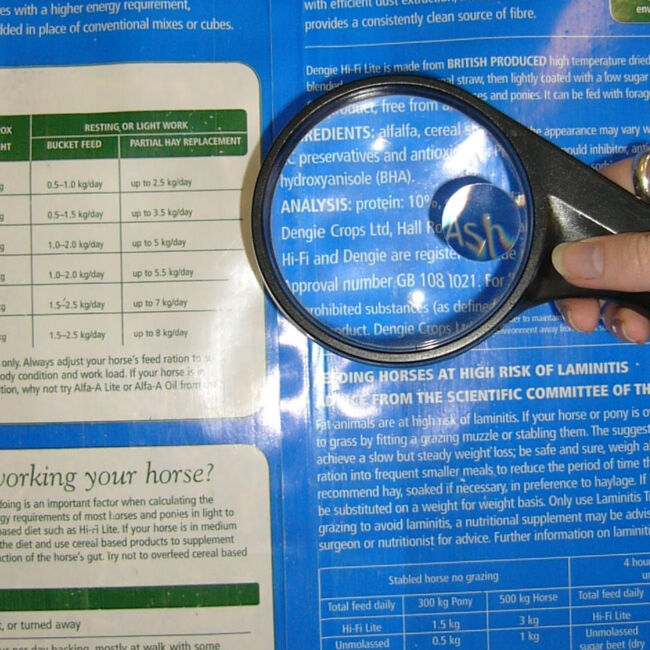
There are certain pieces of information that manufacturers are legally required to put on a bag of feed and these are found in the “statutory statement” which can be found printed directly on the bag or on a stitch in label in some cases. Probably of greatest interest to horse owners are the nutrient levels (analytical constituents) and the ingredients list (composition), but there’s also other additional useful information such as additives and the best before date of the product in the statutory statement as well.
Not all nutrient levels have to be declared by the manufacturer. Sugar and starch, for example, do not have to be listed unless a claim has been made that the product is low in sugar or starch and there are rules that even go so far as to say that energy mustn’t be listed in the statutory statement. This is because there is no official calculation for measuring energy for horses. Calculations developed for other species have been used for many years because they are the next best option, so many manufacturers choose to put the information elsewhere on the bag. This is why, with the Dengie Alfa-A and Hi-Fi ranges, the energy level is usually included in the text at the top of the bag.
In the analytical constituents section, nutrients such as protein are usually shown as a percentage. When comparing feeds, it is important to look beyond the percentage and consider how much of the feed is actually fed each day. The feeding rate determines the true amount of nutrient your horse receives. For example, Feed A may contain 10% protein and be fed at 1kg per day, providing 100g of protein. Feed B may contain 20% protein, which sounds higher, but if it is only fed at 500g per day, it also provides 100g of protein. This means both feeds supply the same amount of protein at their recommended feeding rates.
The list of ingredients must be declared on the bag and are in descending order of inclusion. Whatever there is most of in the feed comes first on the list and whatever there is least of comes last. If you wanted to feed a cereal free feed for example, and you spotted oats in the ingredient list you would know that this feed isn’t for you.
What doesn’t the label tell you?
If manufacturers are using top-quality raw materials in their feeds, they will want to tell you about it, so this information will probably be found elsewhere on the bag. For example, the level of oil and the type of oil used will be listed in the statutory statement but, if a really good-quality oil has been used, such as linseed, the manufacturer is bound to be talking about the added benefits of omega-3 fatty acids somewhere else on the bag.
Some raw material names can cause confusion. Oat feed is a good example of this because the word oat leads many horse owners to assume that oat feed could make their horse or pony fizzy and they wonder why it is included in a bag of “cool” mix. In fact, oat feed is high in fibre and low in starch, and it provides delete and change to as the quick-release energy found in the grain itself. This is why oat feed is often used in low-energy feeds because it helps to dilute the energy value of the grains themselves. You might also be interested to know that oats are actually the lowest-energy cereal, largely because they contain so much fibre – this is one of the reasons they were traditionally fed to horses.
Sugar beet is another raw material that also causes confusion. Understandably, the name sugar beet implies that it contains lots of sugar, which it does before the sugar is extracted for use in human foods. The fibrous residue or “pulp” that is left is what is used for horses and other animals. The extraction process is pretty efficient, so the fibrous pulp usually contains less than 5% sugar. Some companies add a little molasses to make it more palatable, but there are sugar beet products available, such as Dengie Alfa-Beet, that are molasses-free.
The pulp contains lots of highly digestible fibre and Dengie funded a PhD study to investigate the possible benefits of adding sugar beet to a horse’s diet. The trials showed that sugar beet actually helps to improve the digestibility of other fibre in the diet. In other words, your horse gets more out of the rest of the fibre in its diet when sugar beet is fed. This is why the combination of alfalfa and sugar beet in Alfa-Beet is so effective at promoting weight gain.
You might also have noticed terms like “micronized” or “extruded” on the bag. These are different cooking techniques used to improve the digestibility of the starch that cereals contain. Just as you or I would cook potatoes or pasta before we eat them to make them more digestible, cooking cereals for horses helps to reduce the risk of problems such as colic and laminitis. It is always advisable to use feeds that contain cooked cereals. If the feed you use just lists barley rather than micronised barley, it probably means that it hasn’t been cooked, so is less digestible.
An ingredient that gets a lot of bad press is molasses because it is believed to add lots of sugar to a feed. It is important to note that the standard molasses coatings used by manufacturers contain about 40% sugar but, if they are applied at relatively low levels, the amount of sugar supplied is small. For example, the molasses in Alfa-A Original supplies only 100g of sugar for every kg fed, which is the same amount of sugar that hay would supply, too.
Animal, vegetable or mineral?
The form in which different ingredients are supplied to the horse greatly affects the ease with which the nutrients they contain can be utilised. Minerals are essential for your horse’s health, even though some of them are required only in relatively small amounts. In their inorganic form, minerals are prone to interacting with one another, which reduces their availability. To stop this, they can be chelated, which basically means attaching them to another molecule such as a protein, which effectively makes them organic. Minerals that are organic, such as those that come from alfalfa, are often more available to the horse. The benefits of this were reported more than 20 years ago when trials on hoof quality were carried out. The improvements seen in hoof growth rates and hoof quality were attributed to the high bio-availability of the calcium and other nutrients in the alfalfa.



Expert advice at your fingertips
If you’re looking for advice on the best feed, speak to one of our highly experienced nutritionists on our feedline, or for a more in-depth plan, fill out our Feed Advice Form