

Quick Links
What should I feed my horse to build muscle?
A question frequently asked on the Dengie Feedline is “What should I feed to help my horse build muscle?”. Unfortunately, the answer isn’t as simple as adding a supplement or changing the feed. Muscle development in horses relies first and foremost on an appropriate exercise programme, because muscle can only grow in response to being used – a retired horse who spends most of its time in the stable is unlikely to see much muscle gain. This same principle applies to people; muscles need to be used, and no amount of protein shakes or supplements will help if physical activity is limited.
That said, alongside a suitable exercise regime, nutrition can play a key supporting role in improving muscle tone. To build topline in horses, they need a sufficient supply of amino acids, which are the building blocks of protein, as well as enough dietary energy (calories) to maintain a healthy bodyweight. Horses can obtain protein from various sources including grass, forage and their bucket feed. However, it’s not just the quantity of protein that matters, and the protein quality is just as important.
What is protein?
Protein is an essential component found in all tissues in the body, making up about 20% of its composition, second only to water. It’s not just muscle either; enzymes, hormones and antibodies are also made of protein, which highlights its essential role in maintaining health.
Proteins are made up of chains of amino acids linked by peptide bonds. The type and function of the protein is dependent on both the length of the chain and the specific amino acids included. There are 20 main amino acids which can be sequenced in lots of different ways, with each chain being up to around 400 or more amino acids in length. After protein is consumed in the horse’s diet, the peptide bonds are broken down in the horse’s stomach and small intestine, before individual amino acids are absorbed and can be utilised by the body.
While the horse’s body can produce some amino acids on its own, there are nine which must be obtained through the diet. These are termed “essential” or “indispensable” amino acids because the body can’t produce enough to meet its needs.
The quality of a dietary protein source is typically judged by the levels of the essential amino acids it contains. This means that protein sources which contain a higher proportion of essential amino acids are generally considered to be of better quality.
What is lysine and why do horses need it?
Lysine is one of the essential amino acids, meaning it must be supplied in the diet. It’s also the only amino acid for which a specific daily requirement has been determined in horses. In addition, lysine is what’s known as the first limiting amino acid. This means that while there can generally be an abundant amount of protein in the diet, the horse can still be protein deficient if they aren’t having enough lysine. Think of it like building a house – you can have plenty of bricks but if you don’t have enough mortar then you can’t complete the job.
How much lysine does a horse need?
Lysine requirements will be dependent on the horse’s level of physical activity, age and breeding status. For example, a lactating broodmare or a top-level competition horse will have higher requirements than an adult horse in light work. Lysine is also particularly important for youngstock because a deficiency can limit growth and development.
Protein deficiency in horses
Generally, if enough energy is consumed, which can be identified by the horse being in good body condition, the overall amount of protein in the diet is likely to be sufficient as well. However, despite an adequate protein intake, it is possible for a horse to still be lacking sufficient essential amino acids for horses, like lysine. This is most likely to occur in horses that have restricted grazing and forage, such as good doers or overweight horses.
Signs of protein deficiency in horses can include:
- General non-thriftiness
- Poor hoof and coat quality
- Loss of muscle mass
- Lower growth rates in young horses (as identified by lower than average daily gain)
- Reduced milk production in lactating mares
For good doers on restricted diets, even if a suitable powder or pelleted balancer is included, in many cases this will still not be sufficient to meet the horse’s daily lysine needs. To top up, including a low calorie chopped fibre that contains alfalfa can be a great choice. Chopped fibres are beneficial to increase chew time and fibre intake and can also be fed prior to exercise to reduce acid splash – particularly important for horses prone to gastric ulcers. However, feeding high levels of a pure chopped alfalfa feed may be too calorific for horses that are good doers, so using a feed that combines alfalfa with chopped straw is an ideal lower calorie alternative.
Another good way to top up lysine intake, especially for horses who are stabled for extended periods, is to feed 1-2 mugs of Dengie Alfalfa Pellets in a treat ball. This is perfect for keeping them entertained and foraging for longer, whilst also providing a source of good quality protein and lysine.
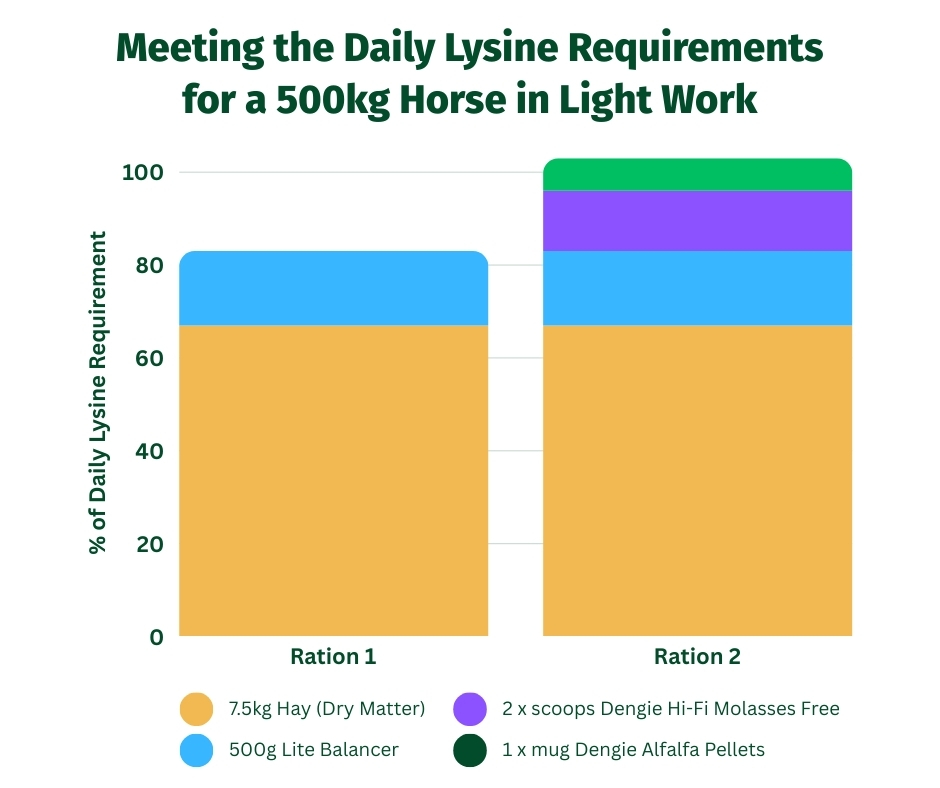
Ration 1: Feeding minimum quantities of hay plus a balancer isn’t enough to meet daily lysine requirements
Ration 2: Adding a chopped fibre feed containing alfalfa and/or 1-2 mugs of Alfalfa Pellets is a great way to top up your horse’s daily lysine intake.
A lysine deficiency in horses can also occur at times of higher demand coupled with inappropriate nutrition, such as during pregnancy, lactation and growth. In these cases, incorporating chopped or pelleted alfalfa into the diet, like Dengie Alfa-A Original or Alfa-A Molasses Free, can make a really valuable contribution, alongside plenty of good quality forage and nutritionally balanced feed.
Muscle supplements for horses: are they worth it?
For horses who are struggling to build topline, there is a growing trend to add specific ‘muscle building’ supplements, often promoted for their high amino acid content. However, these products can be expensive, typically costing around £2 to £3 a day for a 500kg horse – potentially adding up to more than £1000 a year*.
Furthermore, when examining the amino acids provided by such supplements, common feed ingredients like alfalfa frequently supply superior levels. For example, feeding just 2-3 scoops of a chopped alfalfa feed, such as Dengie Alfa-A Original, or 1kg of Dengie Alfalfa Pellets daily will deliver higher levels of most amino acids than many muscle supplements on the market, including whey or pea protein-based products. Since many horses are already fed a scoop of chopped fibre with each meal, switching to an alfalfa-based option is a simple and cost-effective alternative without the need for additional supplements.
For good doers, it’s worth noting that even just one mug a day of Dengie Alfalfa Pellets will supply greater levels of many amino acids than the recommended amount of spirulina-based muscle supplements, including around three times the lysine content. This also works out considerably more cost-effective, at around 16p a day*, so it’s a great way to top up your horse’s amino acid intake without adding too many calories or breaking the bank. Feeding a Stubbs scoop of a chopped fibre like Dengie Alfa-A Original can provide almost six times the lysine content of such supplements.
Why is alfalfa so high in amino acids?
Alfalfa belongs to the legume family – the same as peas, beans and clover. Alfalfa has a deep root system that enables it to access water and minerals deep in the soil. In many cases, alfalfa roots can reach 4 or 5 metres deep, which is more than double the root depth of typical grass and cereal plants. This extensive root network help alfalfa to fix lots of nitrogen from the environment and put it back into the soil, as well as incorporating it into the plant tissue itself as amino acids, which can then be transferred to the horse when the alfalfa is eaten.
In addition, the protein content of alfalfa is at its highest when the plant material is still young. At Dengie, we use precision drying techniques to conserve the alfalfa, meaning there is less reliance on the sun to dry the crop, and so harvest can take place earlier before the plant is fully mature. This means the alfalfa produced is more digestible for the horse and higher in natural nutrients.
To put this into context, Dengie’s Alfa-A range of feeds typically supply around 0.8% of the essential amino acid lysine – approximately twice the level found in average grass hay. Just two Stubbs scoops of Dengie Alfa-A Original can deliver around 20% of the lysine requirement for a horse in light work, while just one scoop of Dengie Alfalfa Pellets provides an impressive 45%. Feeding alfalfa therefore means there is far less reliance on the forage and other feeds or supplements to fulfil the horse’s total daily intake.

Are there any other benefits of feeding alfalfa to horses?
Like other plants, alfalfa makes sugar when photosynthesising but if it makes more sugar than it needs, it stores any surplus as starch in its roots – the part that horses don’t eat! This makes alfalfa a fantastic choice for horses who can be fizzy or excitable, as it supplies a comparable calorie content to a cool mix or cube but with about 10 times less starch.
Furthermore, studies back in the early 2000s (Nadeau et al., 2000; Lybbert et al., 2007) showed that alfalfa was more beneficial for horses with ulcers compared to grass forages, as the high levels of calcium and magnesium it contains act as natural buffers to acidity. The very low levels of starch in alfalfa are also key to its usefulness for all horses, but especially those with ulcers. More information on the benefits of alfalfa can be found here.
Summary
- To develop muscle tone in a horse, an appropriate exercise regime is essential
- The diet should contain sufficient protein, with the quality of the protein being just as important as the amount
- Lysine is an essential amino acid and needs to be included in the horse’s diet
- Alfalfa is a fantastic source of good quality protein and essential amino acids, including lysine, and offers a fibre-based and cost-effective alternative to protein or “muscle building” supplements
- For good doers, incorporating fibre feeds containing a blend of alfalfa and chopped straw is an ideal choice
- Alfalfa pellets can work well in a treat ball to keep stabled horses entertained for longer whilst also topping up their intake of good quality protein
References
- Nadeau et al (2000) Evaluation of diet as a cause of gastric ulcers in horses. American Journal of Veterinary Research. Jul;61(7):784-90.
- Lybbert et al (2007), Proceedings of Annual Convention of the AAEP, Orlando, Florida, 2007.
*All prices correct as of June 2025