


Equine Metabolic Syndrome (EMS)
The European College of Equine Internal Medicine define EMS as “a collection of risk factors for endocrinopathic laminitis”. So what does this mean?
The first key point to note is that EMS in horses is a syndrome which means there are known risk factors or symptoms but the direct cause is not always understood. In the case of EMS, this means we know these risk factors increase the risk of laminitis, but we just don’t know why in every case. Our understanding has increased compared to when the term EMS was first introduced but there is still more to learn.
The other key point is that they are risk factors which means that not every horse or pony with one or more of these risk factors will go on to develop laminitis. However, the chances are greatly increased especially if a combination of unfavourable circumstances all happen at once i.e. the perfect storm of risk factors occurs!
Lastly, endocrinopathic laminitis is laminitis that occurs as a result of disruption to the endocrine (hormone) system in the body. There are other causes of laminitis but endocrinopathic causes are widely accepted to be the most common in equines in the UK due to high levels of obesity in the leisure horse population in particular.
Insulin dysregulation (ID) is considered to be the key feature of EMS that predisposes a horse to laminitis. The risk factors associated with EMS are really the factors that cause ID in horses. Chronic obesity is the key risk factor for ID and there have been studies to show that feeding diets high in non-structural carbohydrate (NSC) (sugar and starch) can reduce insulin sensitivity in horses currently at a healthy weight. Further work has shown that horses that became obese on diets that were high in fat/oil but with a low glycaemic value did not demonstrate reduced insulin sensitivity (Bamford et al, 2016). Whilst it is clearly not advocated for any animal to be obese, this study suggests that the use of high NSC feedstuffs is a particular risk factor for ID compared to those that are high in fibre and/or oil.
Long term use of these feeds is thought to contribute directly to increased risk of ID but has also been shown to alter the microbiota in the digestive tract. Chronic alterations to the microbiota are being linked to metabolic issues in humans and other species but are very difficult to research in the horse as so many factors influence the microbes in the gut.
These feeds are typically energy dense and consumed quickly so also contribute to weight gain if not fed at appropriate levels.

Adipose tissue (fat) has the ability to produce hormones which are the chemical messengers in the body and when there is a lot of adipose such as in obese individuals, it can disrupt the normal balance of hormones produced. Obesity does also appear to be associated with chronic, low-grade inflammation which can predispose those that are overweight to other inflammatory issues too. Research studies have been inconclusive in horses with some studies finding equine metabolic syndrome cases to have a reduced anti-inflammatory state rather than a chronic pro-inflammatory state.
The most significant hormonal change is to insulin function. Hyperinsulinaemia is the term used to describe elevated levels of insulin which can occur as a result of reduced insulin sensitivity – because the insulin doesn’t have the usual effect, the pancreas produces more and more insulin so levels in the blood go up and up. However, studies have shown that hyperinsulinaemia can occur independently of horses being insulin resistant and so other issues can clearly affect the endocrine system too.
Hyperinsulinaemia has been shown to cause laminitis in both research trials and field-based reports. A recent study (Sundra et al, 2021) suggests that hyperinsulinaema seems to be linked to the pain experienced by horses with laminitis. In cases where insulin levels had been reduced medically, there was a marked reduction in lameness even when there was radiographic evidence of rotation of the pedal bone. It is important to note that the medications used are not approved for use in the UK yet (as of 2023) and were only considered for horses where dietary and management changes had not been successful in reducing hyperinsulinaemia.
One of the consequences of ID is that horses and ponies have an abnormal response when they consume sugar and starch (NSC) even in small amounts. Under normal circumstances eating sugar and starch results in an increase in blood glucose levels. The body concurrently releases insulin to control levels of glucose in the blood so eventually levels of both glucose and then insulin return to normal. Individuals with ID can already have higher resting levels of insulin in their blood and then may experience a very exaggerated or prolonged response to the intake of sugar and starch.
A study by Macon et al (2021) demonstrated that very low levels of NSC can elicit this exaggerated response in those with ID. However, it is important to note that the feed was consumed in around 10 minutes and so it is our belief that it isn’t just levels of NSC in feeds that matter, the rate at which the feed is consumed is really important too. See feeding recommendations below to learn more about this key strategy for managing horses with EMS.
Signs and symptoms of Equine Metabolic Syndrome
Unfortunately, it is usually recurrent episodes of laminitis that initiate investigations into whether a horse or pony has EMS. The following are additional indicators for EMS:
- Abnormal fat storage such as a cresty neck or fat pads
- Repeated incidents of laminitis
- Difficulty in achieving weight loss
If these symptoms are apparent your vet is likely to suggest carrying out some tests to determine if your horse has elevated basal insulin levels (hyperinsulinaemia) and potentially also testing your horse’s response to glucose to see if there is an exaggerated insulinaemic response which would be an indicator of ID. If EMS and ID are confirmed, management and dietary changes are recommended.
Management of Equine Metabolic Syndrome
If a horse or pony has been diagnosed with insulin dysregulation and/or EMS, it is recommended to keep them off pasture completely. This is because grass contains relatively high levels of sugar and a horse or pony can consume large amounts very quickly especially when pasture quality is good and abundant.
For longer term management of horses with EMS, it may be possible to turn out for a limited amount of time on a limited area of pasture depending on pasture quality. For more guidance on this click here.
Whilst the energy or calorie value of the forage is important for trying to achieve weight loss, for horses with EMS, it is very important to consider the level of sugar the forage contains too. A low sugar forage isn’t necessarily a low calorie one as energy or calories come from fibre and oil as well as NSC. Forages that contain highly digestible fibre supply more energy to the horse than those that are higher in indigestible fibres such as straw.
Sugar and energy levels in forages
Grass is usually left to grow to maturity before being cut to make hay to maximise yields. This means it is higher in fibre and contains a much higher proportion of indigestible material than when it is young. The older a plant is when it is harvested, the less digestible it is likely to be and therefore the animal consuming it won’t be able to extract as many nutrients and energy from it.
The level of sugar in forage is influenced by lots of factors including the plant variety as well as weather conditions. Grass produces sugar when it photosynthesises and stores any that it doesn’t use for growth. Grass hay contains a range of sugars in simple forms such as monosaccharides and disaccharides as well as storage forms which are longer in chain length such as fructan. Water soluble carbohydrate (WSC) analysis includes all of these forms of sugar. Levels of WSC in hay can typically range from around 10% to 35% and the recommendation for those with EMS is between 10 and 12%.
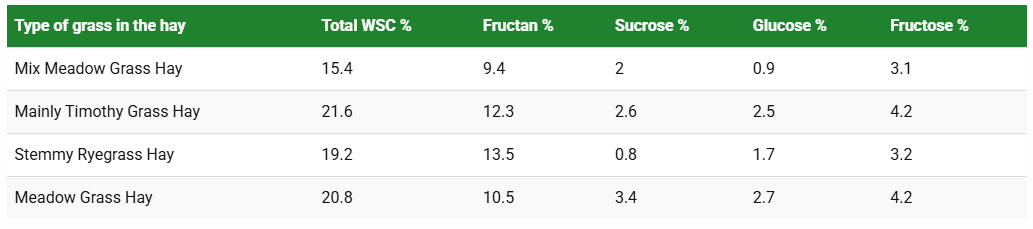
The table below shows how hard it can be to find forage that is suitable for those with EMS. None of the 4 different types of hay sourced from around the UK were below 12% WSC and the types of grass that would be expected to be lowest in sugar, weren’t! In the table the hay that contained predominantly Timothy was higher in sugar than that which contained Rye grass. This illustrates why it is important to analyse forages to determine their suitability for horses and ponies with EMS.
Table 1 Some example sugar levels in grass forages (Longland et al, 2014)
Soaking hay to reduce sugar levels
If hay is being soaked to reduce the sugar content there are lots of factors to consider, not just the time. Firstly the ratio of hay to water is important and current advice is to use as much water as possible to maximise the leaching of sugar. Some researchers have advocated 10 parts water to 1 part hay but this simply isn’t practical for everyone to do. The general principle is to use as much water as you can whilst taking into consideration the fact that water is a very precious resource – using rainwater for soaking hay is one possible solution. The other factor to consider is that warmer water will remove more sugar too. Again it is not practical for everyone to use warm water but studies have shown that around 16C was optimum for sugar removal.
If you can use lots of warm water then it is suggested around two hours will help to reduce sugar levels without losing too much dry matter from the hay. Soaking for longer starts to increase losses so the horse then has to consume more to ensure they receive sufficient fibre intake. In warmer conditions, soaking for more than two hours is also likely to result in the hay starting to ferment and this is not desirable for then feeding to horses. Studies have shown that soaking for longer periods such as 9 hours, also increased the microbial contamination in the hay. Researchers suggest this could potentially cause digestive upsets but how significant this issue is remains to be confirmed as soaked hay has been fed for many years to lots of horses without apparently causing extensive problems. In principle, in cool conditions, it is therefore acceptable to soak hay overnight if you want to but it is important to be aware that the microbial load in the hay will be increased and more is likely to need to be fed to compensate for the dry matter lost from soaking for a long time.

What’s the best way to soak hay?
Techniques for soaking hay vary but there are now specialist tanks available that have drains and that are on wheels for easy manoeuvrability. If these are out of your budget range then dustbins or even an old bath can be used too. The benefit of a bath is that it has a plug and so the used water can be removed easily without having to lift or tip heavy containers. It also means the hay can be left in while the water drains off so that it is a bit lighter by the time it needs to be used.
Straw is a low sugar and low calorie forage and can be used to partially replace grass based forages. Click here for more information on feeding straw.

It is widely recommended for supplementary feed and forage to supply less than 10% NSC on a dry matter basis for those with EMS but the study by Macon et al (2021) showed that even a low NSC feed elicited an exaggerated insulinaemic response in horses with ID. Whilst this is concerning, it is important to note that the balancer was consumed within 10 minutes.
Other studies exploring the use of straw as a forage source found that when rate of intake was slowest in the evening, there was no discernable insulinaemic response (Jansson et al, 2021). Whilst this related to the forage ration, if we can slow the rate of intake of a balancer as well, it is likely to reduce the insulinaemic response too. Providing a balanced diet with respect to vitamins and minerals is important for horses with equine metabolic syndrome and so balancers and supplements are great options as they are typically low in NSC. If they are fed with a large helping of chopped fibre feed so they are consumed really slowly, it should help to reduce the insulinaemic response even in ID horses.
SGLT2 Inhibitors for Horses
Canagliflozin and etugliflozin are new medications for horses with equine metabolic syndrome. In September 2024 a group of leading vets published a letter in the Vet Record highlighting concerns about a number of cases of hyperlipaemia developing as a result of the use of SGLT2i medications. Due to these incidents the vets issued the following recommendations:
“the medications are used only in horses that have failed to respond adequately to appropriate dietary and exercise management or those with significant active laminitis” and “owners should be informed of the potential adverse effects and be counselled to be vigilant for the clinical signs of hyperlipaemia.”
In response to this we have compiled a checklist for all the dietary management and other actions that we believe can and should be taken before resorting to medication. Click here to view the checklist.
0.8% of their bodyweight on a dry matter basis, which is over half the daily intake suggested for a dieting pony in such a short space of time. As horses are capable of compensatory eating behaviour when restricted by time, reducing time at grass alone is not a recommended method of grazing restriction for weight management.
FAQ’s
References
- Frank N, Elliott SB, Chameroy KA, Tóth F, Chumbler NS, McClamroch R. Association ofseason and pasture grazing with blood hormone and metabolite concentrations in horses withpresumed pituitary pars intermedia dysfunction. J Vet Intern Med 2010; 24:1167-75.
- Jansson et al (2021) Straw as an Alternative to Grass Forage in Horses—Effects on Post-Prandial Metabolic Profile, Energy Intake, Behaviour and Gastric Ulceration. Animals.
- Macon et al (2021) Postprandial insulin responses to various feedstuffs differ in insulin dysregulated horses compared to non-insulin dysregulated controls. Equine Veterinary Journal.
- Moore-Colyer et al (2014) The effect of five different wetting treatments on the nutrient content and microbial concentration in hay for horses. PLoS One, 9(11), p.e114079.
- Sundra et al (2023) Preliminary observations on the use of ertugliflozin in the management of hyperinsulinaemia and laminitis in 51 horses: A case series, Equine Veterinary Education
- Wray H, Elliott J, Bailey SR, et al. Plasma concentrations of inflammatory markers in previously laminitic ponies. Equine Veterinary Journal