


Feeding the Overweight Horse or Good Doer
Read the following information and then complete the quiz questions at the end of the page to test your knowledge and earn AMTRA points.
This resource will introduce you to the following topics:
- Why is obesity a problem?
- Identifying obesity – has the horse got a problem?
- Why should I feed an overweight horse?
- Understanding Dengie feeds for overweight horses
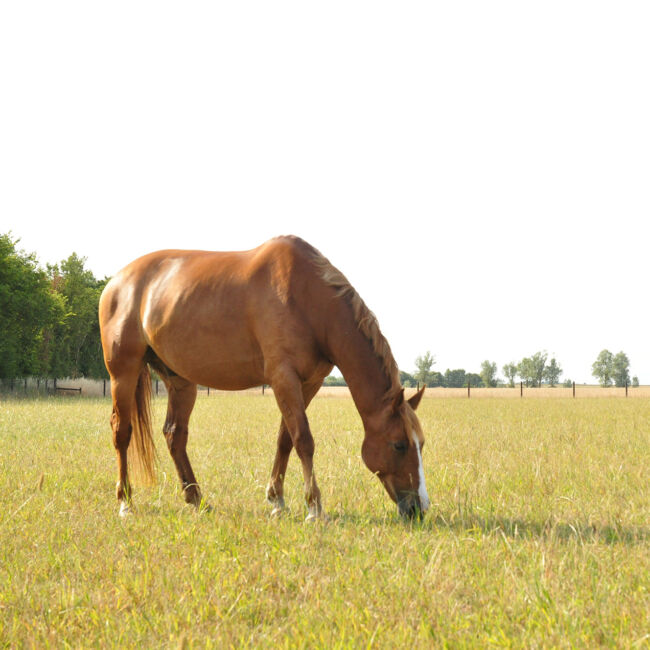
The overall impact on health and wellbeing!
- Increased risk of laminitis especially for those with Equine Metabolic Syndrome (EMS)
- Stress and strain on the joints
- Less tolerant of heat
- Reduced performance or exercise intolerance – which may display as laziness
- Fertility or foaling problems in broodmares
- Many people don’t realise that their horse is overweight and at increased risk of disease and poor health.
- We’ve become accustomed to accepting obesity as the norm.
- Two tools to aid in the identification of obesity are Fat Scoring and weigh taping to monitor weight over time.
- An equine nutritionist will be able to advise on fat scoring and put together an individual weight management plan.
Watch the video below to learn how to fat score a horse
Which of the following pictures A-D shows a horse at a healthy weight?

What should I feed an overweight horse?
- Remove unnecessary extras first – a handful of this, or a cup of that – it all adds up!
- ½ a Stubbs scoop of High Fibre Cubes provides almost as much energy as 1kg of hay – which one is going to keep the horse chewing and occupied for longer?
- Think about why we feed horses and ponies if their energy requirements are met from grazing or conserved forage alone.
Why do we need to feed an overweight horse?
- To encourage weight loss, we need to reduce calories consumed, but it is still important that a horse has a nutritionally balanced diet for good health.
- UK pasture and forage commonly lack the trace minerals copper, selenium and zinc and conserved forage also lacks vitamin E.
- Horses on restricted grazing or forage may also miss out on lysine, which is an essential amino acid and building block of protein.
Given the dietary shortfalls in UK pasture and forage…
- All horses and ponies need supplementing with an additional source of vitamins and minerals.
- This can be provided in the form of:
- A feed fortified with vitamins and minerals
- A balancer
- A powder broad-spectrum vitamin and mineral supplement
What’s the difference?
The table below demonstrates the differences in nutrient contribution between a fortified feed (Dengie Healthy Hooves Molasses Free), a balancer and a vitamin and mineral supplement.

A fortified feed supplies a balanced ration when fed at the recommended quantity. For Healthy Hooves Molasses Free, this is 500g or 1 Stubbs scoop per 100kg of the horse’s bodyweight. When fed at the recommended quantity, a balanced ration is provided and no additional vitamin and mineral supplements are required for horses working up to a moderate level. To feed at the recommended quantity to an overweight horse, the amounts need to be considered as part of the total daily dieting intake, and as such Healthy Hooves Molasses Free may need to replace some of the forage ration. If fed at less than the recommended quantity, simply top up with a broad-spectrum vitamin and mineral supplement or balancer.
A balancer is a concentrated feed. The feeding rate is much lower than a fortified feed, at typically 100g per 100kg of bodyweight per day, and so is great for providing nutrition without too many calories.
A powder broad-spectrum vitamin and mineral supplement is the lowest calorie way to provide vitamins and minerals. Simply add to a handful of chopped or soaked fibre feeds. Compared to a pelleted balancer, a broad-spectrum vitamin and mineral supplement doesn’t provide as much lysine. For those on soaked forage or straw as part of the forage ration, a balancer may be a more appropriate option.
Introducing Dengie feeds for the overweight horse
- For overweight or good doer horses and ponies, the following fibre feeds are low calorie options providing 8.5MJ or less per kilogram to form the basis of the ration.
- Any of these can be fed as a double handful in the 30 minutes pre-exercise to help reduce the risk of acid-splash – this is what happens when the horse moves on an empty stomach and can result in gastric ulcers.

- Our lowest calorie feed providing just 5MJ/kg of digestible energy, which equates to just 1.25MJ per Stubbs scoop.
- Soft, tasty meadow grasses blended with high-quality oat straw to offer a low-calorie feed which does not compromise on chew time.
- Meadow Lite with Herbs contains pea hull fibre, which a great source of highly digestible fibre. A range of fibre types is beneficial for digestive health and helps to support a healthy microbiota.
- Meadow Lite includes the tasty herbs cinnamon and thyme to tempt fussy horses and ponies.
- The inclusion of postbiotics supports the gut microbiota for general health and wellbeing.
- A very light dressing of linseed and rapeseed oil is added to promote coat shine.
- It is naturally low in sugar at 3% and starch at 0.5%.
- Can be used as a partial or total forage replacer when only higher calorie forages are available.

- A soft, tasty blend of chopped straw and grass with grass and alfalfa pellets for added interest, a light rapeseed oil coating, ADM Protexin In-Feed Formula and a herbal blend.
- Ulser Lite supplies 8MJ/kg of digestible energy and 3.2MJ per Stubbs scoop.
- Ulser Lite is low sugar and starch at 6.5% and 2%, respectively.
- With the inclusion of alfalfa and pre-, pro- and postbiotics, Ulser Lite supports the gastric health of the dieting horse.
- Can be used as a partial or total forage replacer when only higher calorie forages are available.
The Hi-Fi Range
- Nutritious low calorie fibres: nutrient-rich higher calorie alfalfa is diluted with lower calorie fibre sources such as straw to produce an overall low calorie feed.
- Combine with a broad-spectrum vitamin and mineral supplement or balancer to balance the ration.
- For overweight horses or good doers, simply feed enough to carry the supplement/balancer, or use products like Hi-Fi Lite as a lower calorie partial or full forage replacer.
- If adding a supplement, feed dampened and mix well and prevent the supplement falling to the bottom of the bucket.

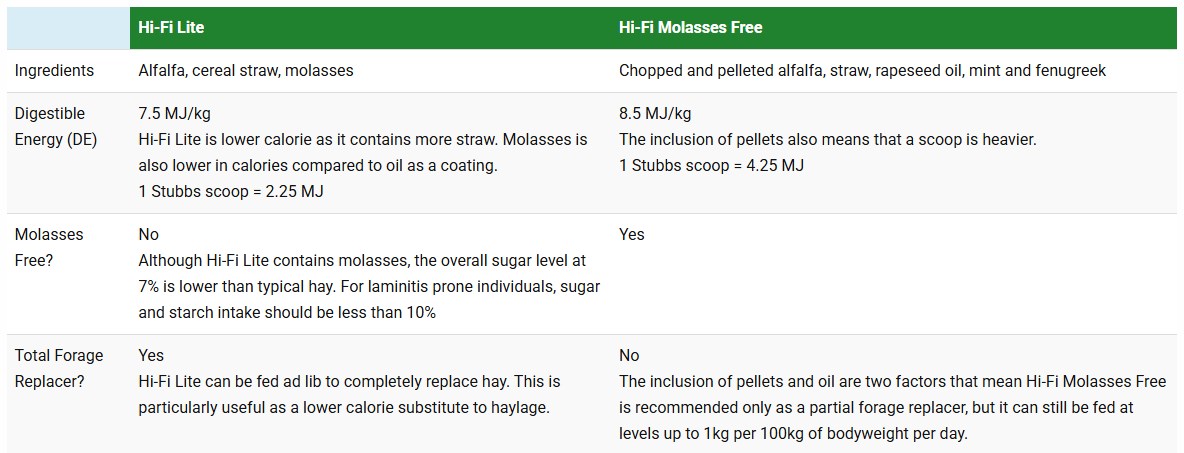
Common Question: What’s the difference between Hi-Fi Lite and Hi-Fi Molasses Free?
Hi-Fi Original – the economical option
- Hi-Fi Original combines chopped alfalfa and straw with a molasses coating and supplies 8MJ/kg of digestible energy.
- A Stubbs scoop supplies approximately 3.2MJ.
- Hi-Fi Original supplies over 66 scoops per 20kg bag.
- A combination of chopped, precision dried alfalfa and grasses with a molasses and oil coating.
- Provides 8.5MJ/kg DE, which equates to approximately 2.55MJ per Stubbs scoop.
- Hi-Fi Senior is softer and easier to chew for the elderly horse that struggles with dentition.
- Useful for the fussy feeder who may not be as keen to eat straw based feeds.
- Hi-Fi Senior can be used as a total forage replacement for those that struggle to chew or for when forage is in short supply.
Summary
- For more information see our Weight Management Guide
- For good doers and overweight horses and ponies, reduce unnecessary extras but ensure the diet is balanced by feeding a supplement or balancer alongside a low calorie fibre feed. Alternatively, use a low energy fortified feed at the recommended quantity.
Test your Nutrition Knowledge!
It’s now time to put into practice what you have learnt about feeding the good doer or overweight horse. Answer all the questions below correctly to receive your Dengie Nutrition Certificate, plus you can earn TWO AMTRA Suitably Qualified Person (SQP) points. To ensure your points are awarded please make sure that you include your unique AMTRA number in the box provided with your details.
* Required