

Liver Disease in Horses
The Horse’s Liver
The liver comprises around 1-1.5% of a mature horse’s bodyweight and is the largest internal organ in the body, working in partnership in some way with almost all the other organs.
This means it is involved in numerous functions, including:
- Producing bile to digest fat
- Producing cholesterol and special proteins to help carry fats through the body
- Producing proteins for blood plasma, e.g., albumin
- Converting excess glucose into glycogen for storage and back again for energy supply
- Regulating levels of amino acids which form the building blocks of proteins
- Processing haemoglobin
- Converting ammonia to urea
- Clearing the blood of drugs and toxins
- Regulating blood clotting
- Producing immune factors and removing bacteria from the blood stream
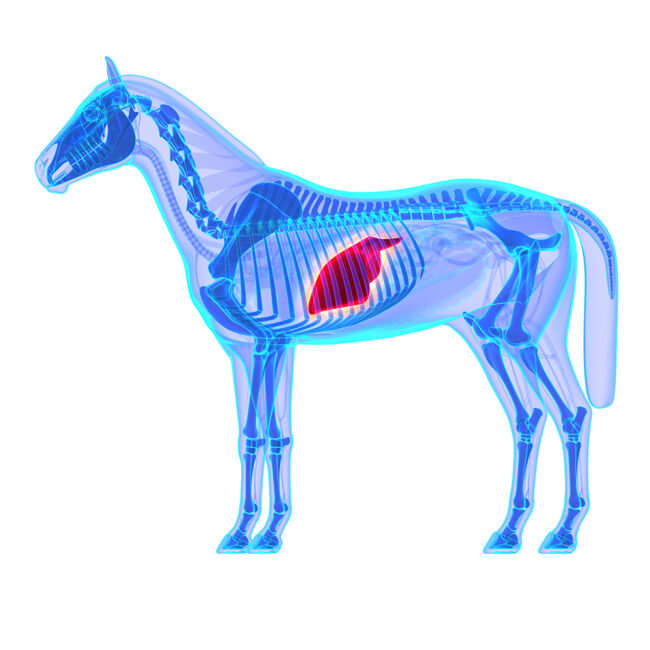
The liver is a highly active organ and so has a large energy requirement. When the health or function of the liver is compromised, the aim is to provide what the horse requires without stressing the liver too much; in other words meet but not exceed what is required.
Many of the signs of liver disease are non-specific, such as lethargy, diarrhoea, weight loss, fever, decreased appetite, colic symptoms and depression. This means it can be really difficult to recognise and diagnose, especially in the early stages. More specific liver disease symptoms include photosensitivity, especially on white or pink areas of skin such as the horse’s muzzle, and jaundice, which is a yellowing of the whites of the eyes, skin and gums. In more severe or serious disease states, neurological signs may be evident such as the horse pressing its head against a wall. The severity of the clinical signs and the extent to which the liver is damaged or failing will significantly affect the prognosis for the horse.
It is important to note that many signs of liver damage do not appear until the disease is reasonably developed, so it’s important to contact the vet as soon as a problem is suspected. The vet will usually request a detailed history of your horse’s management and may perform various tests to diagnose the problem. For example, a blood test will usually show raised liver enzymes and can be an indicator of liver disease. Other diagnostic methods can include ultrasound scanning and a liver biopsy. The vet will be able to advise in more detail which tests are most appropriate and what the results mean.
Whilst diagnostic tests can help to identify the problem, they don’t necessarily offer an indication as to the cause, which may remain a mystery. A vet may consider blood testing other horses on the yard, even if they are not showing clinical signs, as this could help to identify possible causes of the problem depending on whether others are affected. Liver disease has multiple potential causes, and can be associated with underlying conditions, such as metabolic issues or septicaemia. Many horse owners are aware of the effects of ragwort poisoning on the liver but there are actually a wide range of problems and causes that can also result in liver damage, some of which are more common than others. These can include:
- Mycotoxin contamination in feeds or forage – mycotoxins are toxins produced by moulds that can be present in pasture, grains or conserved forages. They can’t be seen with the naked eye but there are thousands of different types. The understanding of their effects across all species, including humans, is relatively limited. However, raised liver enzymes or liver disease is a common issue as a result of mycotoxin ingestion, due to the liver’s role in removing toxins.
- Hepatitis – this is most basically defined as inflammation of the liver and may develop following the ingestion of toxins, or as a result of a viral or bacterial infection.
- Obstructive causes – these can include right dorsal colon displacement (a form of colic) whereby the movement of the large intestine places physical pressure on the liver and blocks the bile ducts (Gardner et al, 2005).
- Liver fluke – this is a parasite that is more commonly found in sheep and cattle but it can also infect horses on shared grazing and tunnel into the liver. Although horses have previously been thought to be fairly resistant to liver fluke infection, more recent research has indicated that this is not necessarily the case and that it may be an under-diagnosed cause of liver disease (Howell et al, 2020).
- Hyperlipaemia – this most commonly occurs in obese animals who have had their feed intake dramatically reduced, and is characterised by excessive levels of fat in the blood.
- Tyzzer disease – this is caused by a bacterial infection which can result in the breakdown of liver tissue. This disease is rare and usually only affects very young foals.
- Liver tumours – liver cancer in horses is rare but in some situations, tumours which develop elsewhere in the body can also spread to the liver. A biopsy is the only way to confirm this diagnosis.
- Hepatic encephalopathy – this is slightly different in that it is a neurologic condition caused by reduced liver function. If the liver is not working at full capacity in its role in clearing toxins from the blood, these toxins may build up and affect the horse’s nervous system.
Key Principles of Feeding Horses with Liver Disease
In many cases, the diets of horses with liver disease may not need to be significantly different from those of healthy horses. However there are some considerations to take into account. When feeding a horse with very severe liver problems, it has historically been recommended to feed a low protein and low oil diet. This was thought to help to minimise further ammonia build up during protein metabolism and reduce excess liver fat accumulation, thus minimising pressure on the liver. However, research over the last 10-15 years by respected vets such as Professor Andy Durham of Liphook Equine Hospital suggests protein is less of a concern than originally believed and that dietary restriction is not required (Durham, 2013). Furthermore, reports in human medicine are now indicating that protein restriction in people with liver disease should be actively avoided as excessive restriction may actually worsen liver function (Cordoba, 2014; Merli et al, 2019). If dietary protein is being overly-restricted, the body goes looking for it elsewhere and may start to break down muscle as an alternative. We therefore want to meet but not significantly exceed protein requirements.
People are often worried about higher percentages of protein levels on feed labels. However it is important to also consider the amount fed and not just percentage. The table below shows how a feed that appears to be low in protein actually supplies more than a balancer with a much higher protein percentage. The feeding rates given ensure the right levels of vitamins and minerals are supplied – feeding less of either feed will mean the diet isn’t balanced.

The jury is out as to whether the amino acid profile of the diet matters to the horse. Humans with liver failure are advised to eat more vegetable protein as it is better than animal protein, but as the horse is a herbivore, it does this anyway! The types of amino acids thought to be beneficial are known as Branch Chained Amino Acids (BCAA) and are found in greater quantities in alfalfa compared to grass and cereals for example.
Historically, it has also been suggested to remove oil from the ration to reduce the amount of bile the liver is required to produce. However, the latest advice is that 0.1ml per kilogram of bodyweight of oil is acceptable for horses with liver disease, and up to 0.5ml per kilogram of bodyweight can be fed for those requiring increased condition (Durham, 2013). This equates to between 50ml and 250ml for a 500kg horse.
As with any horse, for those with liver problems it is also important to ensure that their vitamin and mineral requirements are being met. A good place to start is to use a pelleted balancer or broad-spectrum supplement. These offer a concentrated source of vitamins and minerals, meaning that only small volumes need to be fed. This can help to avoid “over-facing” horses whose appetite may be limited, whilst allowing nutrient requirements to be met whilst avoiding excessive intake. For those holding their weight well, this can simply be combined with a low calorie chopped fibre feed. For poorer doers or those who have lost weight as a result of the disease, additional energy (calorie) sources can be added alongside to help support weight and condition as required.
Where weight gain is needed, unmolassed beet pulp or alfalfa-based fibre feeds can be a suitable, high fibre choice for many horses. For those with no metabolic issues, easily-digestible, soluble-carbohydrate feeds (such as micronised cereals) can also be used to increase calorie intake and improve palatability, as long as meal sizes remain small. Starch intakes should be kept to levels of no more than 1g per kilogram of the horse’s bodyweight per meal – Dengie’s Starch Intake Calculator can be used to check how much you are providing.
Feeding very small amounts of cereal-based feeds at frequent intervals will provide a more continuous supply of energy and keep the stress on the liver to a minimum. The use of cereals is however not advisable if the horse or pony has a history of laminitis or other metabolic conditions such as PPID or EMS, as in these situations it is essential to keep starch intakes low. In some cases it may be necessary to establish which issue poses the greatest threat to health and welfare at that time. Due to the considerations that may need to be taken into account when feeding the horse or pony with liver disease, it can be helpful to consult a nutritionist who will be able to assess your horse’s requirements and advise on a feeding programme tailored to their needs. Some example diets for different situations are given below.
Example diets for horses with liver disease
The following examples provide some guidance for two different situations. A nutritionist will however be able to advise in more detail for individual cases.
To help maintain steady blood glucose levels and minimise pressure on the liver in horses suffering from liver disease, dividing the total daily feed ration into 4-6 smaller meals, or as many as possible, across the day is recommended, especially if cereal-based feeds are used. This will help to reduce the risk of undigested soluble carbohydrates (i.e. starch and sugar) from passing into the hindgut, as well as reducing the ammonia load on the liver through protein metabolism.
In most cases, forage should be provided to appetite and as easy to access as possible – i.e, provided in a bin or from the floor, rather than in a small-hole haynet. The only exception would be in the case of the overweight horse when some limitation may be needed. For horses suffering from photosensitisation, overnight turnout may be preferable to during the day in bright conditions to reduce the risk of skin damage.
For horses with a reduced appetite, consider adding warm water or flavours to the feed to tempt them to eat. General guidance on feeding the fussy horse can be found here.
Summary
- If you suspect your horse may be suffering from liver disease, contact your vet as soon as possible.
- For horses suffering from liver disease, it can be beneficial to seek personalised advice from a nutritionist who will be able to tailor the diet recommendations to your horse’s needs, taking into account any other health problems that may be present.
- General feeding advice includes:
- Use a balancer to provide a concentrated source of vitamins, minerals and protein in small volumes to avoid over-facing your horse
- Remember that we need to still meet our horse’s protein requirements but not overly exceed them
- Feed little and often to keep meal sizes manageable and minimise pressure on the liver
- Suitable supplements may include milk thistle and digestive aids
References
- Howell et al (2020) Fasciola hepatica in UK horses. Equine Veterinary Journal, 52(2), pp.194-199.
- Cordoba (2014) Hepatic encephalopathy: from the pathogenesis to the new treatments. International Scholarly Research Notices, 2014(1), p.236268.
- Merli et al (2019). EASL Clinical Practice Guidelines on nutrition in chronic liver disease. Journal of Hepatology, 70(1), pp.172-193.
- Durham (2013) Hepatic Insufficiency, In: Geor et al, 2013. Equine Applied and Clinical Nutrition: Health, Welfare and Performance. Elsevier Health Sciences.
- Gardner et al (2005) Serum gamma glutamyl transferase activity in horses with right or left dorsal displacements of the large colon. Journal of Veterinary Internal Medicine, 19(5), pp.761-764



Expert advice at your fingertips
If you’re looking for advice on the best feed, speak to one of our highly experienced nutritionists on our feedline, or for a more in-depth plan, fill out our Feed Advice Form