


Forage and Fibre
Read the following information and then complete the quiz questions at the end of the page to test your knowledge and earn AMTRA points.
This resource will introduce you to the following topics:
- Why is fibre important for the horse?
- What are the different types of forage?
- Types of fibre in the bucket

Why is fibre important for the horse?
- The horse is classified as non-ruminant herbivore and has evolved over millions of years with a specialised digestive tract adapted to digest and utilise diets containing high levels of plant fibre.
- As horses have evolved to eat a high fibre diet, their digestive tract is at its ‘healthiest’ when consuming high fibre diets.
- Low fibre diets are linked to poor behavioural and reduced digestive health in the horse e.g. oral stereotypies, colic, and equine gastric ulcer syndrome (EGUS).
- Fibre is fermented in the hind gut by microbes, which produce volatile fatty acids (VFAs), which can be utilised directly, stored as fats in adipose tissue, or converted to glucose.
- This means that fibre makes a very valuable energy source for horses in work – between 30-70% of a harder-working horse’s energy requirement can be met with fibre.
- Whilst we don’t know the horse’s exact fibre requirement, the consensus is that horses should not have less than 1.5% of their bodyweight in forage on a dry matter basis daily, e.g. 7.5kg on a dry matter basis per day for a 500kg horse.
Choosing the right forage
- Overweight horses = less digestible, lower calorie forages to allow a higher intake
- Performance horses = more digestible, higher calorie forages to make a greater contribution to energy intake
- Veteran horses with poor dentition = change the physical format of forage if they can no longer manage hay or haylage – consider a forage replacer feed
- The only way of knowing the nutritional contribution of a forage to the ration is to get it analysed.
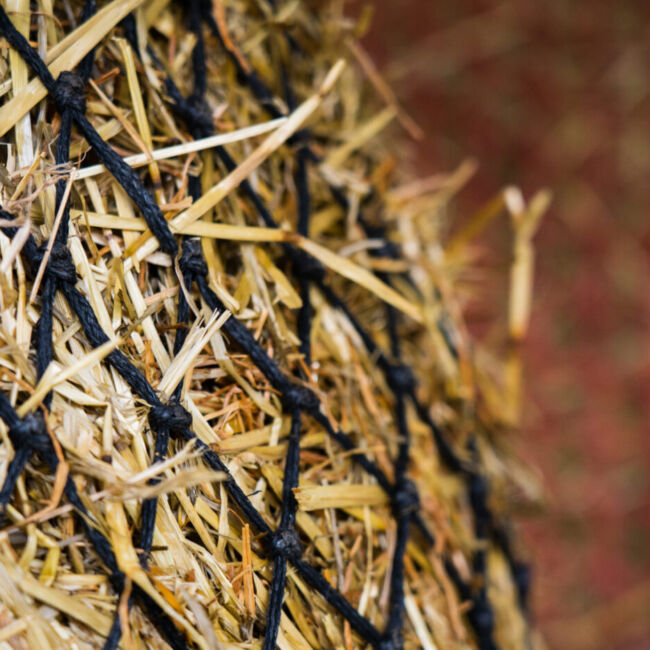
Types of forage
Click on each tab below to reveal the definition.
What’s the difference between hay and haylage?
- The fundamental difference between hay and haylage is the way that the grass is conserved.
- Hay is cut when grass is mature and left to dry in the field before being baled and stored.
- Haylage tends to be cut earlier in the season and is left to wilt for a shorter period of time in the field before being baled and wrapped in several layers of plastic.
- The difference between haylage and hay is that, whilst the conservation of hay relies on the removal of moisture, the conservation of haylage relies on the exclusion of oxygen which prevents mould growth.
- There seems to be an increasing trend to produce drier haylage which is more accurately termed ‘wrapped hay’ as the dry matter is closer to that of hay. Caution has to be taken with very dry haylage when wrapping, as dry, coarse material may result in more air pockets in the bale and a bale that is more difficult to wrap without puncturing the plastic. Both of these factors can mean that very dry haylage is more susceptible to higher mould counts or becoming spoiled during storage as the higher levels of oxygen increases the opportunity for mould growth.
- More information on the differences between hay and haylage can be found here.
Do you need to feed more haylage than hay by weight?
- Yes – you need to feed more haylage than hay by weight to provide the same amount of dry matter.
- For example, a 500kg horse consuming 2% of bodyweight in dry matter = 10kg dry matter: (500 ÷ 100) x 2 = 10
- Hay (approximately 85% dry matter)
- 11.8kg as fed: 10 ÷ (85 ÷ 100) = 11.8
- Haylage (approximately 60% dry matter)
- 16.7kg as fed: 10 ÷ (60 ÷ 100) = 16.7
Straw
- Straw has a very low calorie level compared to other forages, as it contains higher proportions of indigestible materials such as lignin.
- It can be used to dilute more nutritious fibre sources and can help to maximise chew time for good doers and overweight horses. This is especially helpful in situations where it is hard to buy in separate forage, like on a livery yard where forage is provided as part of the livery arrangement.
- The latest studies are showing that between 30-50% of the total forage ration as straw can help to achieve weight loss and is safe to use, with no ill effects seen for horses with EGUS.
- Replacing ⅓ of average hay with straw amounts to about a 16% reduction in energy/calories – the reduction will be even greater if replacing a better quality forage.
- Mixing straw into the hay net also slows the overall rate of intake.
- However, straw may be best avoided for those with dental or respiratory problems.
Fibre types in the bucket
You may notice some different fibre types listed on the ingredients labels on feed bags. At Dengie, we predominantly use alfalfa, straw and dried grass in our feeds, along with other fibre sources like sugar beet pulp and pea hull fibre. Each of these is explained in more detail below.
- Also known as ‘lucerne’.
- Alfalfa is a legume and so is a member of the pea and bean family and has deep roots that enable it to access water and minerals deep in the soil – making it a very nutritious crop.
- No additional fertilisers are needed for the alfalfa and the crops that follow in rotation require much less fertiliser too.
- It provides energy from fibre but with around 10x less starch than a typical cool mix – like other plants, alfalfa makes sugar when photosynthesising but if it makes more sugar than it needs, it stores any surplus as starch in its roots – the part that horses don’t eat! This is in contrast to grass which stores sugar as water soluble carbohydrates in stems and leaves.
- It is very digestible for the horse, which basically means it is easy for the micro-organisms in the horse’s gut to break down the fibre.
- It contains high levels of protein and calcium, both of which buffer acidity in the stomach, making it a useful choice for horses with EGUS.
- It’s a great source of quality protein so is particularly beneficial to working horses and growing youngstock.
- It provides good levels of naturally occurring minerals.
- Included in feeds in either a chopped or pelleted format.
What is precision drying?
- Drying method used for all of Dengie’s alfalfa and grasses.
- Hot driers are used to conserve the alfalfa – this means we are not dependent on the sun to dry the crop and this extends our harvest season.
- Allows a young plant to be conserved and the natural nutrients to be locked in.
- Produces consistently clean forage as any mould spores that may be present are effectively killed due to the high temperatures used.
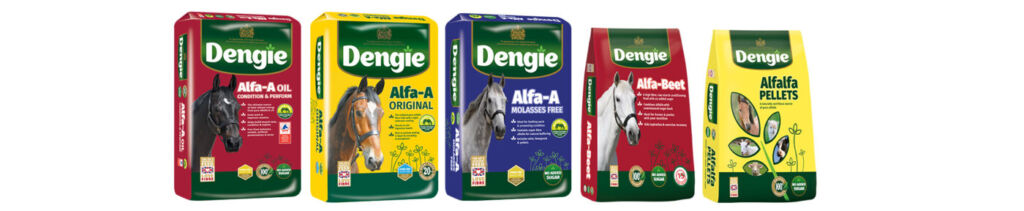
Which products from the Dengie range contain alfalfa?
Because alfalfa is such a beneficial feed ingredient, we use it in nearly all our products, but the main ones are shown below.
- A very digestible source of fibre which is easily broken down by the horse.
- Needs to be soaked prior to feeding.
- Sugar beet has a calorie level comparable to oats, but without the high starch content.
- Sugar beet without molasses typically contains around 5% sugar as fed, which is lower than hay.
- The reason for this minimal sugar content is because the sugar has been extracted from the sugar beet for use in human nutrition – the sugar beet pulp that is left for use in horse and animal feed is the fibrous residue which is very low in sugar.
- Dengie’s Alfa-Beet combines alfalfa and sugar beet to make a very easily digestible soaked fibre feed which is great for poor doers as well as for those with dental issues.
- The grasses used in Dengie feeds are harvested at the optimum time before they become too mature, meaning that it is easier for the microbes in the horse’s gut to break down the fibre and the nutritional value of the grass can be maximised.
- Dried grass is a source of naturally occurring sugar, meaning that feeds containing it will have a natural sweetness which is great for tempting fussy horses and ponies.
- For horses with a history of laminitis, it may be better to avoid feeds which contain very high levels of dried grass as the overall sugar level of the feed will be higher.
- Like alfalfa, the grasses are precision dried using hot air. This produces a consistently clean fibre source and so is ideal for competition horses or those with equine asthma or other respiratory issues.
- Not just for horses: Dengie Pure Grass Pellets can be fed to a wide range of animals including sheep, goats and cattle as well as camelids such as alpacas.
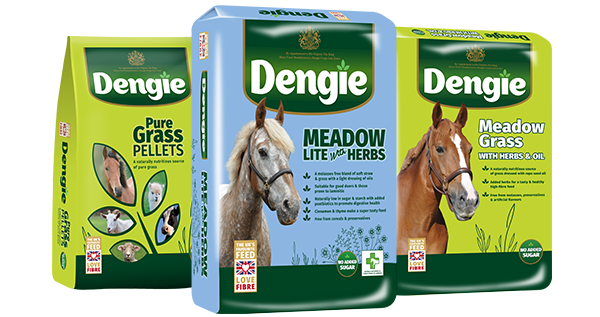
- As well as being used to dilute the main forage portion of the diet, straw can also be chopped to shorter lengths or pelleted and used in bagged feeds.
- At Dengie we use straw as a key ingredient in most of our Hi-Fi range, as well as in Meadow Lite with Herbs to provide a lower calorie ration compared to pure alfalfa or dried grass.
- Since straw is often not the most palatable source of fibre, we add herbs or coatings to help tempt fussy eaters, and the straw is also dust extracted.
- Although straw has very little buffering capability itself, it is still beneficial for gastric health in the sense that it increases chew time and therefore there is a greater saliva production. This is important as saliva contains bicarbonate which helps to buffer acidity in the horse’s digestive tract.

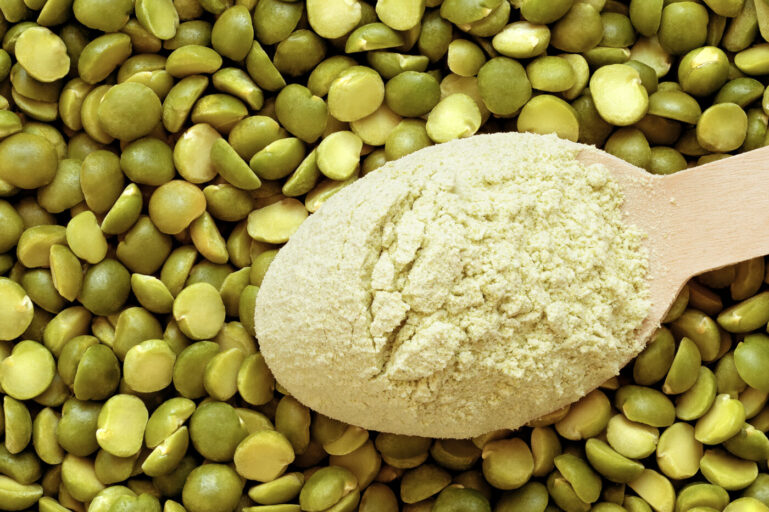
- As the name suggests, the fibre comes from peas and is the hull from the pea itself rather than the pod.
- Pea hull fibre provides a mix of different fibre types whilst being very low in sugar and starch.
- Of the fibre content, around 20% is pectin which is a highly digestible form of fibre for the horse. There is also a very low level of lignin which means the fibre that is present is very easy for the horse to access and utilise – in contrast to more lignified forages like straw and late cut hay.
- The hull is removed mechanically using a gentle brushing and rubbing technique. Air is then used to move the fibre through a grinding process to create a flour-like texture. Heat is applied to ensure it is free from any microbes and therefore safe to use as a feed ingredient.
- Pea hull fibre is included in our Meadow Lite with Herbs.
Summary
- Different fibre types have different benefits for the horse.
- Straw can be used to dilute more nutritious fibre sources and is a useful option for good doers and overweight horses.
- Alfalfa is an easily digestible fibre which is often included in the bucket feed and provides excellent levels of quality protein and calories without the starch.
Test your Nutrition Knowledge!
It’s now time to put into practice what you have learnt about the different types of forage and fibre. Answer all the questions below correctly to receive your Dengie Nutrition Certificate, plus you can earn TWO AMTRA Suitably Qualified Person (SQP) points. To ensure your points are awarded please make sure that you include your unique AMTRA number in the box provided with your details.
* Required